
Why Paper Clutter Accumulates Faster Than You Expect
Mail, school permission slips, utility bills, takeout menus, insurance documents, and expired coupons all land in the same pile. Without a defined home for each category, paper spreads horizontally across every flat surface in a house. The root cause usually isn't laziness - it's the absence of a decision point: a moment where each piece of paper gets sorted into a clear destination.
Professional organizers consistently note that most households don't need a more elaborate system - they need a simpler, more repeatable one. Before choosing any system, it helps to audit what types of paper actually enter your home and how often. See our room audit checklist for a structured way to surface exactly that. For a broader foundation, getting started with home organization covers the core concepts if you're new to the process.
The Four Main Paper-Sorting Systems Compared
Each approach below addresses a different paper volume, lifestyle, and tolerance for maintenance. Understanding the trade-offs is what lets you choose the one most likely to stick.
| Action Inbox | Accordion Folder | Filing Cabinet | Hybrid Digital | |
|---|---|---|---|---|
| Best paper volume | Daily to weekly flow | Low to moderate | Moderate to high | Any volume |
| Setup cost | Very low | Low | Moderate to high | Low to moderate |
| Space required | Minimal | Minimal | Significant | Minimal physical |
| Maintenance frequency | Weekly | Annually | Annually | Ongoing scanning |
| Good for families | Moderate | Less ideal | Yes | Depends on habits |
| Long-term document storage | Needs secondary system | Yes | Yes | Partial - some paper needed |
1. Action-Based Inbox System
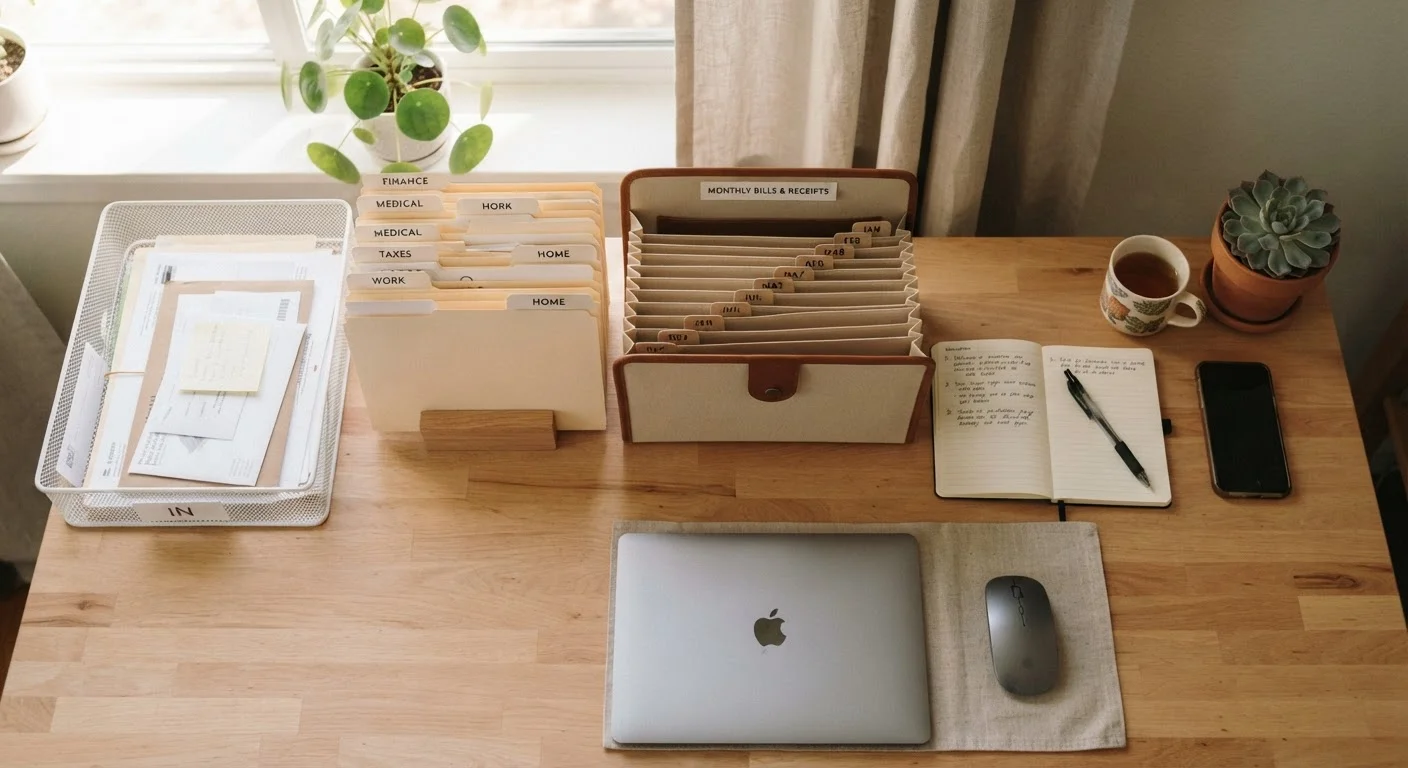
This system uses a small set of physical trays - typically labeled To Do, To File, and To Shred - placed in a high-traffic spot like a kitchen counter or home office entry. Every incoming paper lands in one of these trays immediately. The key discipline is a weekly processing session to clear each tray. It handles the flow of paper well but requires a secondary archive system for long-term documents.
2. Accordion Folder or Binder System
Accordion files and three-ring binders with dividers are compact, low-cost, and well-suited to households with predictable paper categories: taxes, warranties, insurance, vehicle records. They work best when you have a modest, stable document load - not when paper arrives in daily waves. One folder per major life category (home, health, finance, auto) is a common and functional structure.
3. Filing Cabinet with Hanging Folders
A two- or four-drawer filing cabinet scales to larger households with children, home-based work, or heavy administrative paper. Hanging folders with labeled tabs allow for granular categories. The downside is the footprint it requires and the tendency for cabinets to become dumping grounds if folders aren't pruned annually. A once-a-year purge session keeps them functional.
4. Hybrid Digital-Plus-Minimal-Physical System
Scanning or photographing documents and storing them in organized cloud folders reduces physical paper significantly. Key candidates for digitizing include receipts, instruction manuals, and recurring bills. However, some documents - signed originals, legal paperwork, certain tax records - are best kept in physical form. A small physical archive of genuinely irreplaceable documents, paired with digital copies of the rest, represents what many organizers now recommend as a practical middle ground. For a deeper look at when each format works, see our overview of popular organizing approaches.
Start With a 'One In, One Out' Rule
Before building any sorting system, establish a simple rule: every new piece of paper that enters your home gets placed in a defined spot within 24 hours - never just set down. Even a single labeled tray dramatically reduces pile-up. Process that tray at least once a week, and your system will stay functional with minimal effort.
How to Choose the Right System for Your Household
The most reliable predictor of success isn't which system you choose - it's how well the system matches your actual behavior. Ask yourself three questions:
- How much paper enters your home each week? Light loads (a few pieces) suit an accordion folder. Heavy loads need an inbox tray plus a filing cabinet.
- How often are you willing to process paper? Daily processors can manage an inbox tray easily. Once-a-month processors need a more forgiving archive system that doesn't overflow.
- Who else uses the system? Multi-person households benefit from clearly labeled, shared systems. Personal binders work well for solo adults.
If you're drawn to reducing paper altogether, it's worth thinking through the same trade-offs explored in discussions about keeping paper vs. digital copies - the same logic around redundancy and reliability applies at home. For a room-by-room view of how paper organization fits into a broader home strategy, the complete home organization walkthrough offers useful context.
Don't Digitize Without a Backup Plan
Scanning documents and deleting the originals creates risk if your storage device fails or cloud access is lost. Always maintain at least two copies of digitized records - for example, a cloud folder and an external hard drive. For documents with legal or financial significance, consult with a relevant professional before discarding originals, as requirements for retaining physical copies can vary.