

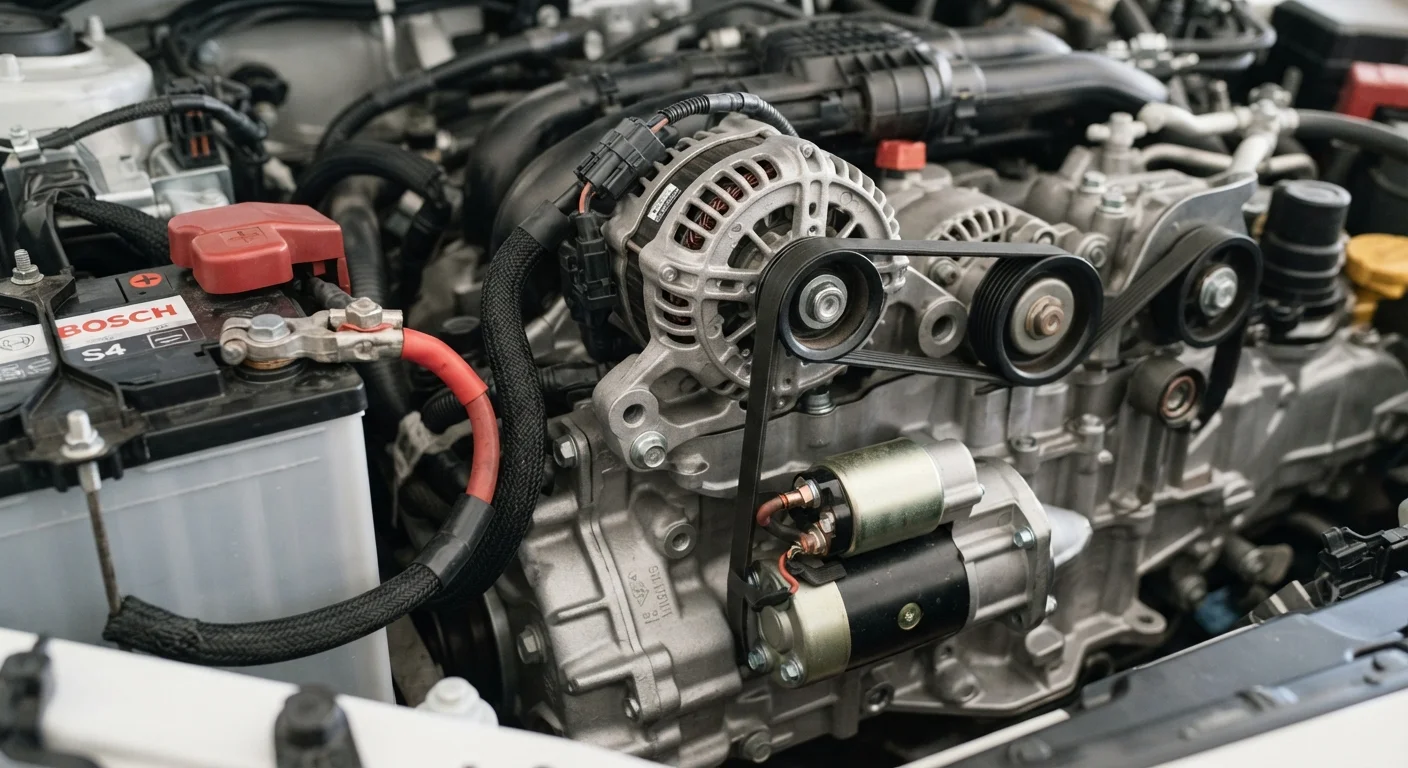
The Three Players in Your Starting System
Your car's ability to start and stay running depends on three distinct components working in sequence: the battery, the alternator, and the starter. Each has a specific job, and when one fails, the symptoms can look deceptively similar - all three can leave you with a car that won't start. Understanding what each one actually does is the first step to diagnosing the real problem.
| Battery's primary job | Provide the initial burst of power to start the engine |
| Alternator's primary job | Recharge the battery and power electrical systems while the engine runs |
| Starter's primary job | Crank the engine so combustion can begin |
| Typical battery lifespan | 3-5 years (varies with climate and usage) (General industry guidance) |
| Alternator output voltage | Typically 13.8-14.8 volts at idle (Standard automotive electrical specs) |
| Key symptom: dead battery | Slow crank or no crank; headlights dim when starting |
Think of it this way: the battery is a reservoir of stored electrical energy. The starter is the mechanical device that uses that energy to spin the engine. And the alternator is the generator that refills the reservoir while the engine runs. Fail any link in that chain, and you're not going anywhere.
What the Battery Does - and How It Fails
The battery stores chemical energy and converts it to electricity on demand. Its most critical moment is the few seconds it takes to power the starter motor during cranking. After the engine fires, the battery plays a supporting role, buffering the electrical system against demand spikes.
A failing battery typically shows these signs:
- Slow, labored cranking - the engine turns over sluggishly before (or instead of) starting
- A clicking sound when you turn the key, with no engine movement
- Headlights or dashboard lights that dim noticeably during start attempts
- The vehicle starts fine when jump-started but dies again quickly without driving
Cold weather accelerates battery decline because low temperatures reduce a battery's ability to deliver current. If your car struggles on cold mornings but starts normally after the weather warms, battery health is a likely culprit. See our seasonal maintenance guide for a full cold-weather checklist, including how to inspect battery terminals for corrosion.
You can test a battery's resting voltage with a multimeter: a fully charged, healthy 12-volt battery should read approximately 12.6 volts or above with the engine off.
What the Alternator Does - and How It Fails
The alternator is belt-driven by the engine and generates AC electricity, which the car's rectifier converts to DC to charge the battery and power all electrical systems while the engine runs. Without a functioning alternator, a fully charged battery will drain within miles of driving.
Alternator failure symptoms are often electrical in nature:
- A battery warning light on the dashboard (sometimes labeled with a battery icon, even though the alternator is the source)
- Flickering or progressively dimming headlights while driving
- Electrical accessories - radio, power windows, climate control - behaving erratically
- A burning rubber or electrical smell from the engine bay
- The car starts fine but stalls or dies after driving for a short distance
When to Call a Professional
Diagnosing electrical system faults can involve live circuits and tight engine-bay spaces. A multimeter test is low-risk, but any physical inspection, component removal, or repair should be handled by a qualified mechanic - especially if your vehicle is under warranty. Never disconnect a battery while the engine is running, as this can damage sensitive electronics.
To test an alternator, start the engine and measure voltage across the battery terminals with a multimeter. A properly functioning alternator should produce between 13.8 and 14.8 volts at idle. A reading at or below 12.6 volts suggests the alternator isn't charging. Above 15 volts can indicate a voltage regulator fault - also a problem worth addressing promptly.
What the Starter Does - and How It Fails
The starter motor is an electric motor that physically cranks - rotates - the engine so that the combustion cycle can begin. It engages only during the starting process and disengages the moment the engine fires. Starters are mechanically robust but wear over time.
Signs of a failing or failed starter are distinct from battery and alternator issues:
- A single loud click when the key is turned, with no cranking at all - this often points to the starter solenoid
- A grinding or whirring noise during start attempts, sometimes with intermittent engagement
- The engine cranks normally when the car is cold but the starter struggles after the engine is warm ("heat soak" is a real phenomenon)
- Jump-starting has no effect - if the battery is good and the engine still won't crank, the starter is suspect
One practical field test: if you hear a loud single click and the battery tests strong (12.6V+), try gently tapping the starter housing with a rubber mallet while someone turns the key. On some worn starters, this temporarily unseats a stuck brush and allows the motor to engage. This is a diagnostic trick, not a repair - a starter behaving this way needs professional replacement.
Because starter replacement involves working beneath or within the engine bay and requires proper torque specs, this job is best left to a qualified mechanic in most cases.