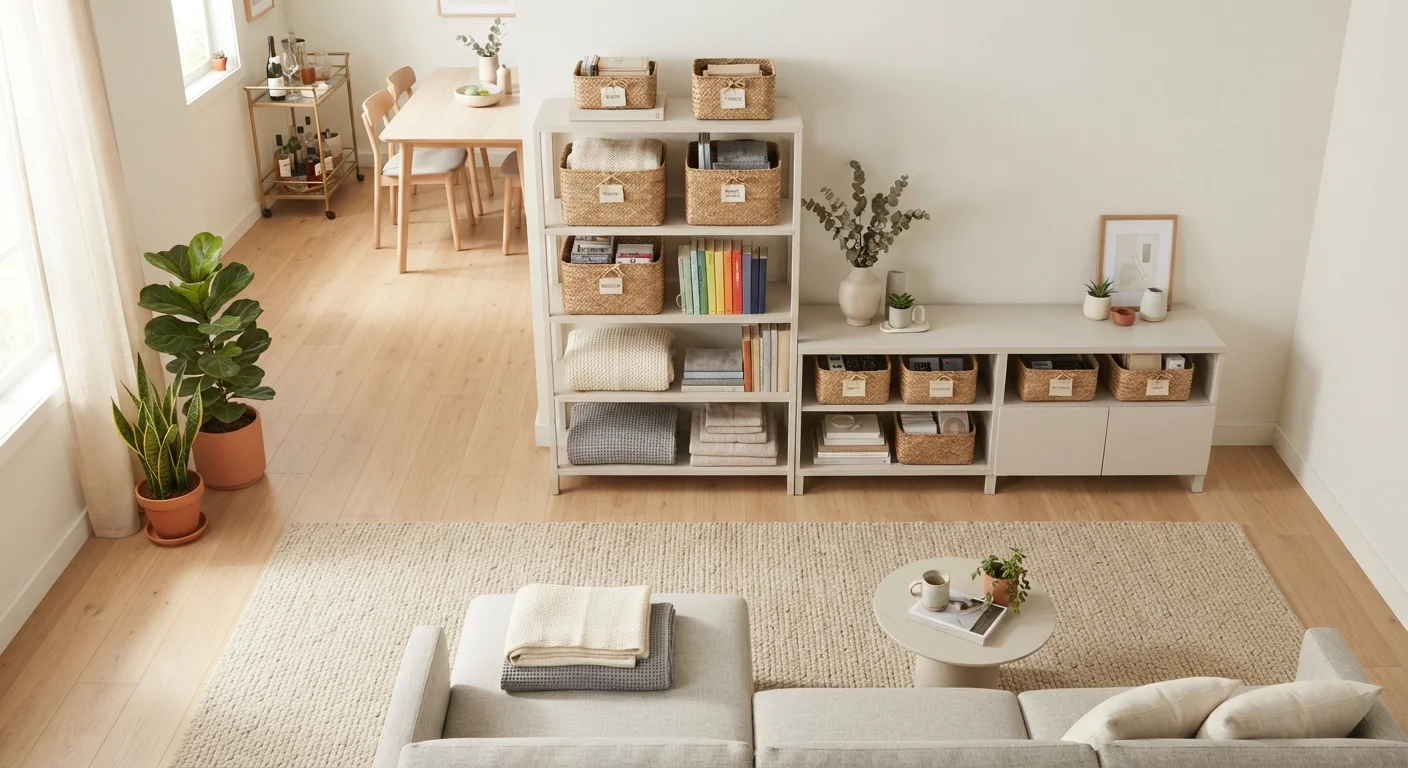

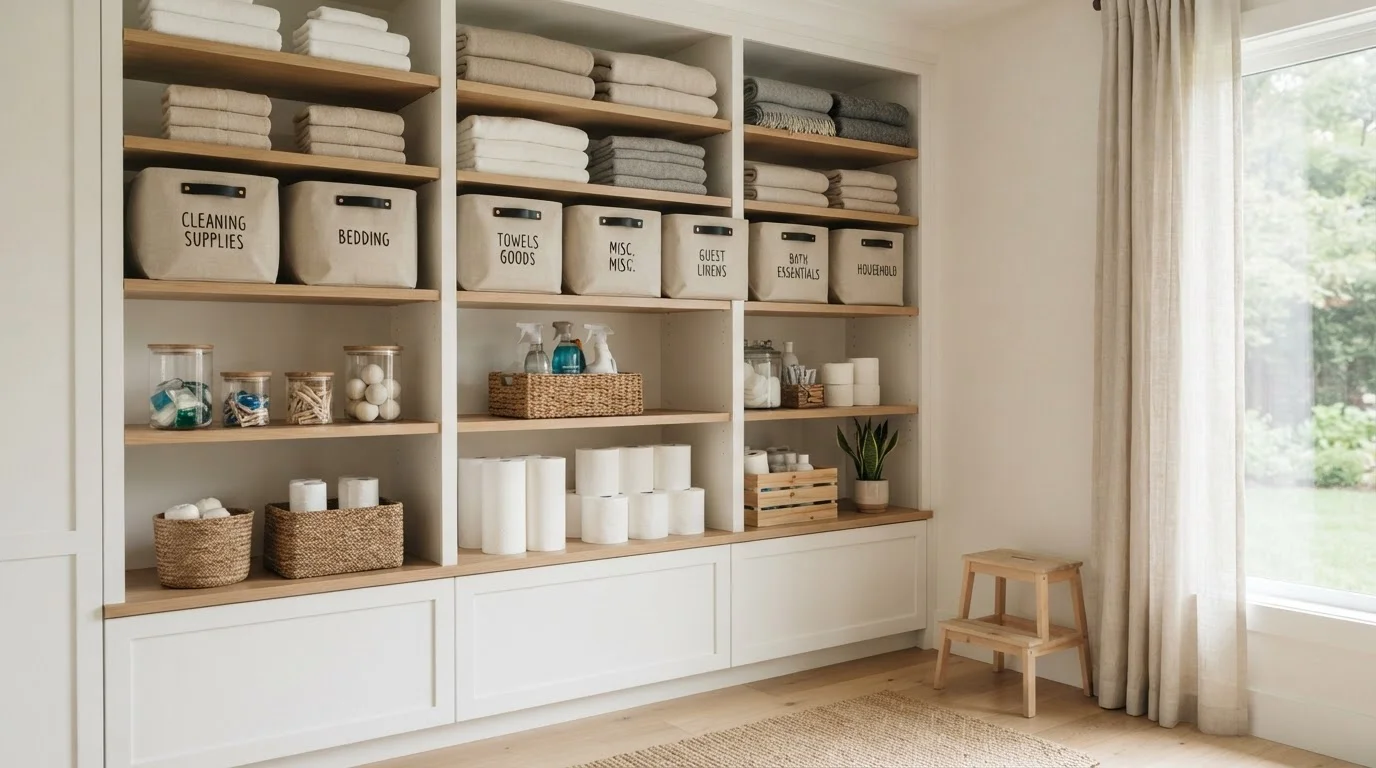
Why Organizing Methods Matter Beyond Aesthetics
Picking up a label maker and a set of matching bins can make any space look tidier - briefly. What keeps a home organized over months and years isn't aesthetics, it's a system with a clear logic your household will actually follow. That's where organizing philosophies come in.
Each method covered here reflects a distinct set of values: what to keep, where to put it, how much is too much, and what to do when things inevitably shift. Understanding those values lets you match the right approach to the right area of your home - or combine methods intelligently rather than starting over from scratch every six months.
If you're new to all of this, this beginner-friendly starting point covers core concepts before you commit to any single method. For those ready to apply these ideas room by room, our complete room-by-room walkthrough shows how different strategies translate into specific spaces.
The KonMari Method
Developed by organizing consultant Marie Kondo, KonMari asks a deceptively simple question about every item you own: does it spark joy? If it doesn't, you thank it and let it go. The method works by category rather than room - you gather all clothing from the entire house before deciding what stays, then move through books, papers, miscellaneous items, and finally sentimental objects.
KonMari's strength is its decisiveness. By confronting every item in a category at once, you avoid the common trap of tidying the same type of clutter across multiple sessions without ever resolving it. Its limitation is equally clear: the emotional framing doesn't translate well to utilitarian categories. A box of spare fuses or a stock of cleaning supplies doesn't need to spark joy - it needs to be accessible and adequately stocked.
Best suited to: households doing a comprehensive one-time declutter, especially for clothing, books, and sentimental items. Less effective as a standalone system for kitchens, pantries, or tool storage. Pairs well with our guidance on letting go of sentimental clutter.
KonMari's category-first approach prevents tidying the same clutter repeatedly without ever resolving it.
FIFO (First In, First Out)
FIFO is a stock-rotation principle borrowed from food service and retail: the oldest items are used before the newest ones. In a home context, this means placing newly purchased items behind existing stock so the front of a shelf always holds what should be used next.
This approach has two practical benefits. First, it dramatically reduces waste from expired or forgotten items - a real cost concern in pantries and medicine cabinets. Second, it makes restocking straightforward: if the oldest item is always at the front, you know at a glance what's running low.
FIFO requires consistent behavior at restocking time, which is its main friction point. Households that add groceries in a hurry will undermine the system unless it's a shared habit. Decanting staples into clear, uniform containers can help by making the rotation visible and automatic.
Best suited to: pantries, refrigerators, medicine cabinets, cleaning supply closets - any storage holding consumables with expiration dates or use-by windows.
FIFO dramatically reduces waste from expired items - a direct cost benefit for any well-stocked pantry.
The Container Method
The Container Method treats physical storage as a fixed constraint rather than something to expand when things accumulate. Each category of item is assigned a specific container - a drawer, a bin, a shelf - and the rule is simple: what fits, stays; what doesn't fit triggers a decision about what to remove.
This approach sidesteps the need for ongoing philosophical evaluation. You don't have to decide if something sparks joy; you just have to decide whether this item earns its place over something else in a container with a defined limit. It's particularly effective for categories that grow quietly over time - kids' artwork, craft supplies, spare cables, seasonal decorations.
The method's success depends on choosing containers that are genuinely appropriately sized - too large and the limit loses meaning; too small and the friction of an under-resourced system creates workarounds. For the relationship between containers and dedicated zones, see our article on how dedicated zones change how rooms function.
Best suited to: shared family spaces, hobby areas, garage storage, and anywhere accumulation is the primary challenge rather than initial overload.
Assigning fixed containers turns 'do we need this?' into a concrete, space-based decision - far easier to enforce.
Zone-Based Organization
Zone-based organizing assigns every category of item a fixed location based on how and where it's used, rather than what it is abstractly. Cooking tools live near the stove; homework supplies live at the homework area; chargers live at the charging station. The zone defines where things live, and living outside the zone is by definition out of place.
This method works especially well in high-traffic multi-use spaces - kitchens, living rooms, home offices - where multiple people with different routines share the same area. Zones create intuitive expectations: everyone knows where something belongs because the location makes functional sense.
Zone-based systems require upfront thought about traffic patterns and actual habits rather than ideal ones. A zone set up around aspirational behavior (a reading nook nobody uses) will fail. Zones should reflect how your household actually moves through a space.
Best suited to: kitchens, shared living areas, home offices, entryways. Works well in combination with the Container Method - zones define where; containers define how much.
Zones work best when they reflect how your household actually moves, not how you wish it would.
The One-In, One-Out Rule
One-in, one-out is less a full organizing system and more a maintenance discipline: for every new item that enters the home in a given category, one existing item leaves. Buy a new jacket; donate one you own. Bring home a new kitchen gadget; remove one you've stopped using.
Its value is in preventing slow accumulation, which is how most organizing systems eventually break down. It doesn't require a dedicated session or a philosophical framework - just a consistent habit at the point of acquisition. The main challenge is enforcement: it's easy to delay the outgoing item indefinitely, which negates the benefit entirely.
One practical approach is pairing it with a visible staging area - a donation box near the door - so the friction of removing the outgoing item is minimal. The habit becomes: bring something in, something goes in the box.
Best suited to: clothing, books, kitchen tools, toys - categories where gradual accumulation is the dominant problem. Functions as a complement to almost any other method rather than a standalone system. This habit is central to breaking the cycle of homes drifting back into chaos.
One-in, one-out works best when the outgoing item leaves immediately - not 'eventually'.
The Four-Box Method
The Four-Box Method is a sorting framework for decluttering sessions rather than an ongoing organizational system. You prepare four labeled containers - Keep, Donate, Trash, and Relocate - then work through a space by placing every item into one of the four boxes without deferring decisions.
The structure forces resolution. Instead of picking something up, deciding it's complicated, and setting it back down, you commit to one of four clear paths. The 'Relocate' box is particularly useful: it acknowledges that some items belong in the home but not in this room, and collects them for redistribution rather than sending them back into the clutter.
The method works best as a starting point - a way to reset a space before implementing a longer-term system. Used repeatedly without a maintenance habit, the same space will return to its previous state within months.
Best suited to: initial declutter sessions in rooms that have accumulated significant disorder - garages, storage rooms, spare bedrooms. Pairs naturally with any storage-based method applied afterward.
The Four-Box Method prevents the most common decluttering pitfall: picking things up without deciding what to do with them.
Choosing and Combining What Works for You
None of these methods requires total commitment to function. Many households benefit from applying FIFO to the pantry and medicine cabinet, the Container Method to kids' toys and craft supplies, and a zone-based approach to shared living spaces - all at once. The goal isn't methodological purity; it's a home that's easier to maintain than to let go.
Start With One Method in One Space
Rather than overhauling your entire home at once, apply a single method to one area - a pantry shelf, a closet, or a junk drawer - and live with it for a few weeks. This reveals whether the system fits your household's actual habits before you scale it. Adjusting one area is far less discouraging than undoing a whole-home reorganization that turned out not to work.
One underappreciated step: revisit your system after a significant life change - a new family member, a move, a shift in work schedule. The method that served a household of two adults may not hold up for a family of four. Understanding why organized homes drift back into chaos helps you anticipate those pressure points before they unravel your system.
For spaces where paper and documents are the main challenge, dedicated paper-sorting systems address what general methods tend to leave unresolved. And for the often-overlooked garage, garage-specific strategies tackle the root causes of accumulation rather than just surface tidying.