

Why Garage Organization Fails the First Time
Most garage organization attempts stall for the same reasons: items are moved rather than culled, storage is added before categories are defined, and there's no system for items that arrive without a home. The result is a tidier-looking garage that reverts to chaos within a few months.
If you're starting fresh or rebuilding after a failed attempt, the principles behind lasting organization matter more than any product you install. For a broader look at building home systems that hold up, see the beginner's guide to home organization - it covers the mental framework that makes specific spaces like the garage much easier to tackle.
When the Garage Needs More Than Organizing
If your garage has structural concerns - damaged flooring, moisture intrusion, inadequate electrical capacity, or poor ventilation - address those issues before investing in a storage system. A well-organized space built on a compromised structure will require rework sooner than expected. For electrical work, gas lines, or structural repairs, consult a licensed contractor and verify whether local permits are required before beginning any work.
Zone Your Garage by Activity, Not Object
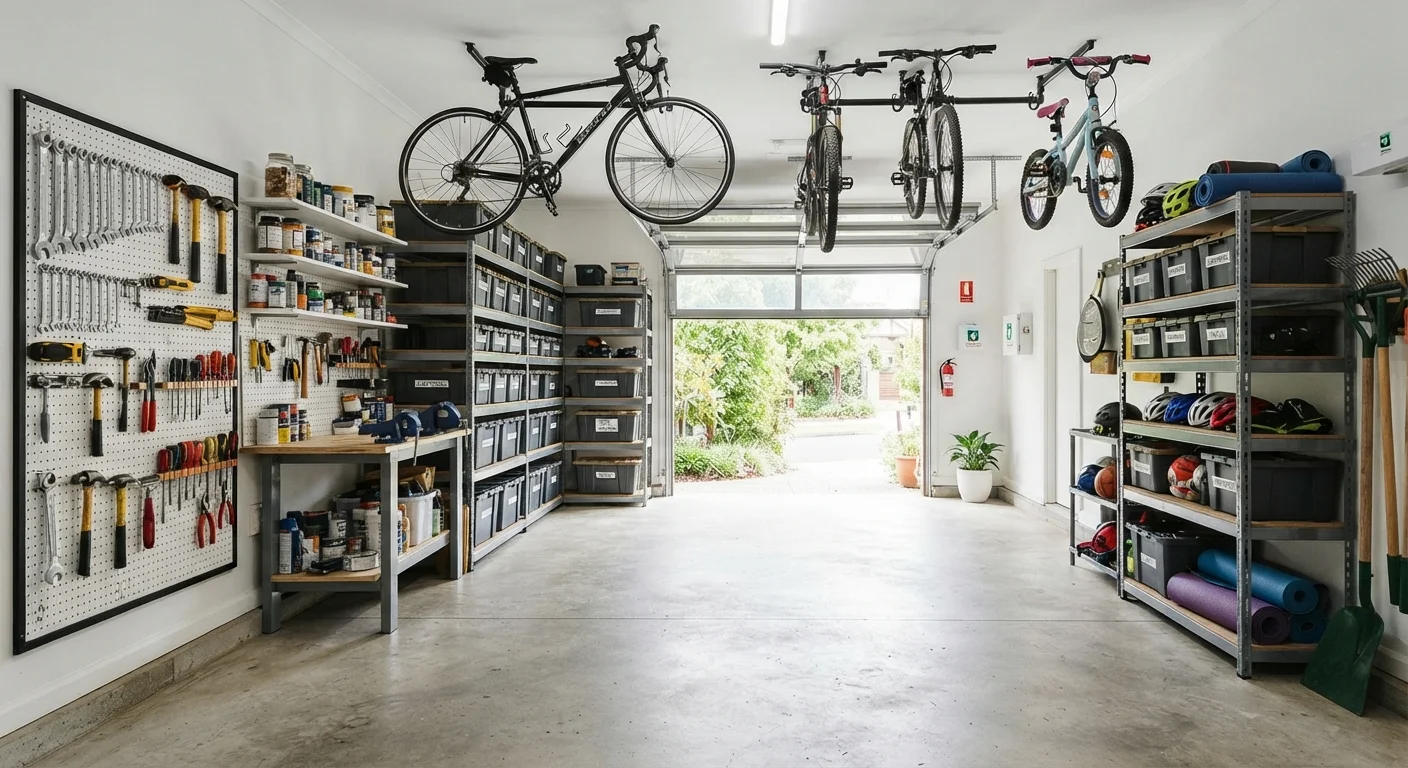
The most durable garage systems are built around how you actually use the space, not around what you own. Instead of grouping all boxes together or all tools in one corner, define activity zones: a car maintenance area near the garage door, a garden and outdoor tools zone near a side exit, a sports and recreation zone accessible to the whole family, and a seasonal storage zone in the deepest, least-accessible part of the space.
This approach works because it mirrors real behavior. When you come in from yard work, you return tools to the garden zone - not to a vague "tools" shelf that competes with power tools and automotive supplies. Zoning reduces decision fatigue and makes it easier to train everyone in the household to maintain the system.
Define activity zones before purchasing any storage hardware.
Buying shelves or bins before you understand your zones leads to mismatched storage that doesn't serve real behavior. Zones create a logical map that all other decisions follow.
Store items at the frequency you use them, not by category alone.
Frequently used items stored at back-of-garage depth create daily frustration and shortcuts. Frequency-based placement reduces workarounds and keeps high-traffic items accessible.
Use uniform, stackable, clear-lidded bins for seasonal and infrequent storage.
Mismatched containers waste vertical space, tip unevenly, and make contents invisible without pulling everything down. Uniformity allows predictable stacking and faster visual scanning.
Designate an 'incoming zone' with a defined maximum size.
Without a controlled landing spot for new items, the garage floor absorbs everything temporarily - and temporary becomes permanent. A capped incoming area forces regular decisions.
Keep car maintenance supplies and tools within reach of the vehicle, not at the back of the garage.
Automotive tasks require frequent tool access, and poor placement leads to workarounds - tools left on the floor, items brought inside. Proximity to the work area is functional, not just convenient.
Use Vertical Space Aggressively
Most garages have 8-10 feet of wall height but store everything within four feet of the floor. Wall-mounted shelving, pegboards for hand tools, overhead ceiling platforms for seasonal bins, and bicycle hooks are all ways to reclaim floor space without building an addition. A clear floor path also has a practical benefit: it keeps the garage safer to navigate in low light and makes it easier to sweep and maintain.
When choosing shelving, weight capacity and adjustability matter more than aesthetics. Fixed shelves look clean but quickly become obsolete when your storage needs shift. Adjustable systems accommodate seasonal changes in what you're storing - camping gear in summer, holiday decorations in winter - without requiring reinstallation. For outdoor-specific storage needs that overlap with your garage, the Garden & Outdoors hub has guidance on tool care and seasonal equipment management.
Label Everything and Create a Return-to-Spot Rule
Labels are the enforcement mechanism of any storage system. Without them, bins look identical, family members guess, and items end up in the wrong zone. Clear, large-font labels on bin fronts - not lids - solve this. For shared households, photo labels or color-coding by zone add another layer of clarity that doesn't depend on reading.
The return-to-spot rule is equally important: every item that leaves its zone gets returned before the next use, not left on a workbench or the floor temporarily. This one habit prevents the gradual drift that causes organized homes to slide back into chaos - a pattern that applies just as strongly to garages as to any other room.
The room-by-room home organization walkthrough also addresses labeling and return habits across multiple spaces, which helps reinforce the same behaviors throughout your home.
Build in Regular Decluttering Checkpoints
Even a well-designed garage system will accumulate overflow if there's no mechanism for removing items that no longer belong. Twice-yearly decluttering - typically aligned with seasonal transitions - keeps the system from silently degrading. During each pass, apply a straightforward filter: Has this item been used in the past 12 months? Does it belong in the garage, or did it land here because there was nowhere else to put it?
That second question matters because garages often serve as overflow storage for the whole house. If you're finding items that genuinely have no home elsewhere, that's a signal to address broader household storage - not just add more shelving to the garage. The small-space storage strategies article offers techniques for creating real homes for items that tend to float between rooms.
“The goal of organizing is not to create a perfect system - it's to create a system everyone in the household can use and maintain without thinking too hard about it.”
— Home Organization Research Group, Professional organizer collective, published guidance on household systems