
What You're Actually Deciding
Choosing between open shelving and closed cabinets in the kitchen isn't purely an aesthetic call - it's a decision about how you actually live and cook. Both systems store your stuff. What differs is visibility, maintenance burden, installation complexity, and how each interacts with your kitchen's size and light.
Open shelving removes cabinet doors entirely, leaving contents on display. Closed cabinets enclose storage behind solid or glass-paneled doors. A third option - increasingly common in remodels - is a hybrid layout that uses shelves in one zone and cabinets in another. Understanding the tradeoffs in each category helps you choose a system that fits your habits, not just your Pinterest board.
For broader kitchen and home organization context, see the room-by-room home organization guide, which covers practical strategies across every space without overcomplicating things.
Open Shelving: The Real Tradeoffs
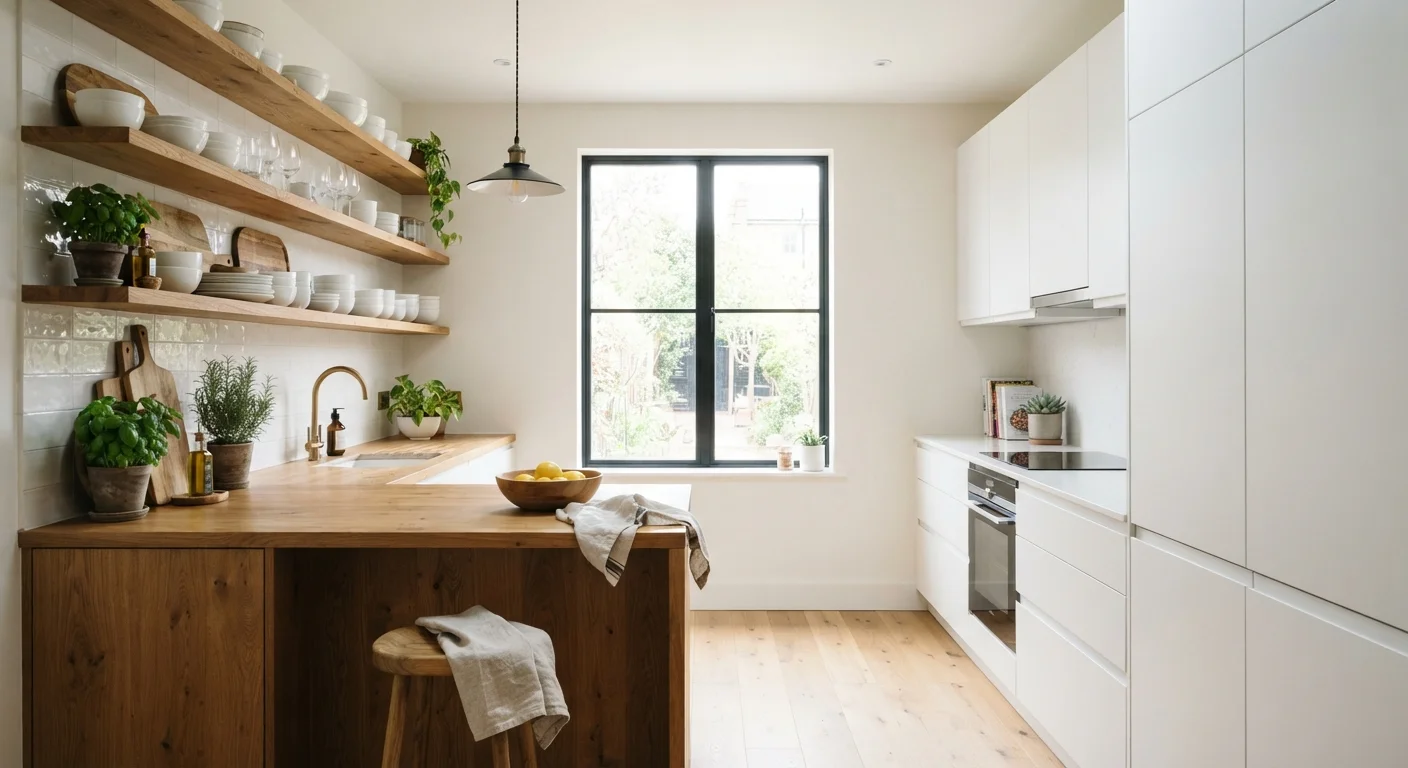
Open shelves make kitchens feel more spacious and are popular in smaller kitchens precisely because they don't visually box in the walls. They also cost less to install than a comparable run of upper cabinets - you're paying for brackets and boards rather than cabinet boxes, doors, and hardware.
The catch is maintenance. Everything on open shelves collects grease, cooking steam, and dust. Items at the back of a shelf may need wiping down more often than most people anticipate. If your household tends toward mismatched mugs, random appliances, and accumulated clutter, open shelves will broadcast that chaos rather than contain it.
They also offer less total storage volume. Without the depth and stacking capacity of cabinet boxes, you'll need to be selective about what you display - and that curation is ongoing work. Households that have worked through a home organizing approach like KonMari - and genuinely reduced their kitchen inventory - tend to find open shelving more manageable than those who haven't.
| Criterion | Open Shelving | Closed Cabinets |
|---|---|---|
| Visual effect | Airy, open, spacious | Clean, contained, structured |
| Upfront cost | Generally lower | Generally higher |
| Maintenance required | High - dusting, tidying ongoing | Low - wipe door fronts occasionally |
| Dust and grease protection | None - items fully exposed | Strong - contents enclosed |
| Storage volume | Limited by display constraints | Higher - deep boxes, stacking |
| Clutter tolerance | Low - disorder is visible | High - hides mismatched items |
| Best kitchen size | Small to medium kitchens | Any size |
| Reversibility | Easy to remove or change | More complex to replace |
Closed Cabinets: Strengths and Limitations
Closed cabinets are the default for good reason. They protect contents from grease and dust, conceal whatever doesn't match or belong, and require almost no daily upkeep beyond wiping the door fronts. For households with kids, mixed kitchenware, or high cooking volume, that containment is genuinely valuable.
They also offer more flexibility in what you store. Deep lower cabinets handle bulk items; upper cabinets can hold seldom-used appliances and serving pieces you'd never want on display. Over time, closed cabinets tend to stay functional regardless of how your décor preferences evolve - they're a neutral container rather than a design statement.
The limitations are cost and visual weight. A full run of upper cabinets is more expensive to install than open shelves, and in a small or narrow kitchen, solid uppers can feel oppressive. Glass-front cabinet doors are a middle-ground option that retains enclosed storage while adding visual lightness - though they still require tidy contents.
~30%
Kitchen remodels that include open shelving
Industry design surveys consistently find open shelving is a minority choice overall, though it has grown in popularity in smaller urban kitchens.
2-3×
More frequent cleaning open shelves require vs. closed cabinets
Home organization specialists generally note that open shelves in active cooking kitchens need wiping down significantly more often than enclosed cabinet interiors.
Making the Hybrid Approach Work
Most kitchens don't need to be all one thing. A common and practical layout keeps lower cabinets (where the bulk storage happens) closed, and uses open shelving selectively above - for everyday glasses, a few cookbooks, or some greenery. This limits the surface area that needs constant tidying while still opening up the upper portion of the room visually.
If your kitchen has an awkward corner or unused wall, open shelves can activate that space without the expense of custom cabinetry. The vertical storage guide covers how to think about wall height as a storage resource - useful framing whether you go with shelves or cabinets. For apartment dwellers or those working with compact footprints, small-space storage strategies offer additional approaches worth considering before committing to either system.
If you're weighing a larger layout change - like opening up walls to create a more connected kitchen - the structural and practical tradeoffs involved are worth examining carefully. See open-plan conversion considerations for a grounded look at what that kind of project actually entails.
Glass-Front Doors: A Middle Ground
If you like the idea of display without full exposure, glass-front cabinet doors offer a practical compromise. Contents stay protected from grease and dust while remaining visible. The tradeoff: you still need tidy, cohesive items behind the glass - mismatched storage containers or random pantry goods will be just as visible as on open shelves. Frosted or reeded glass options let in light while obscuring detail, offering more visual forgiveness.