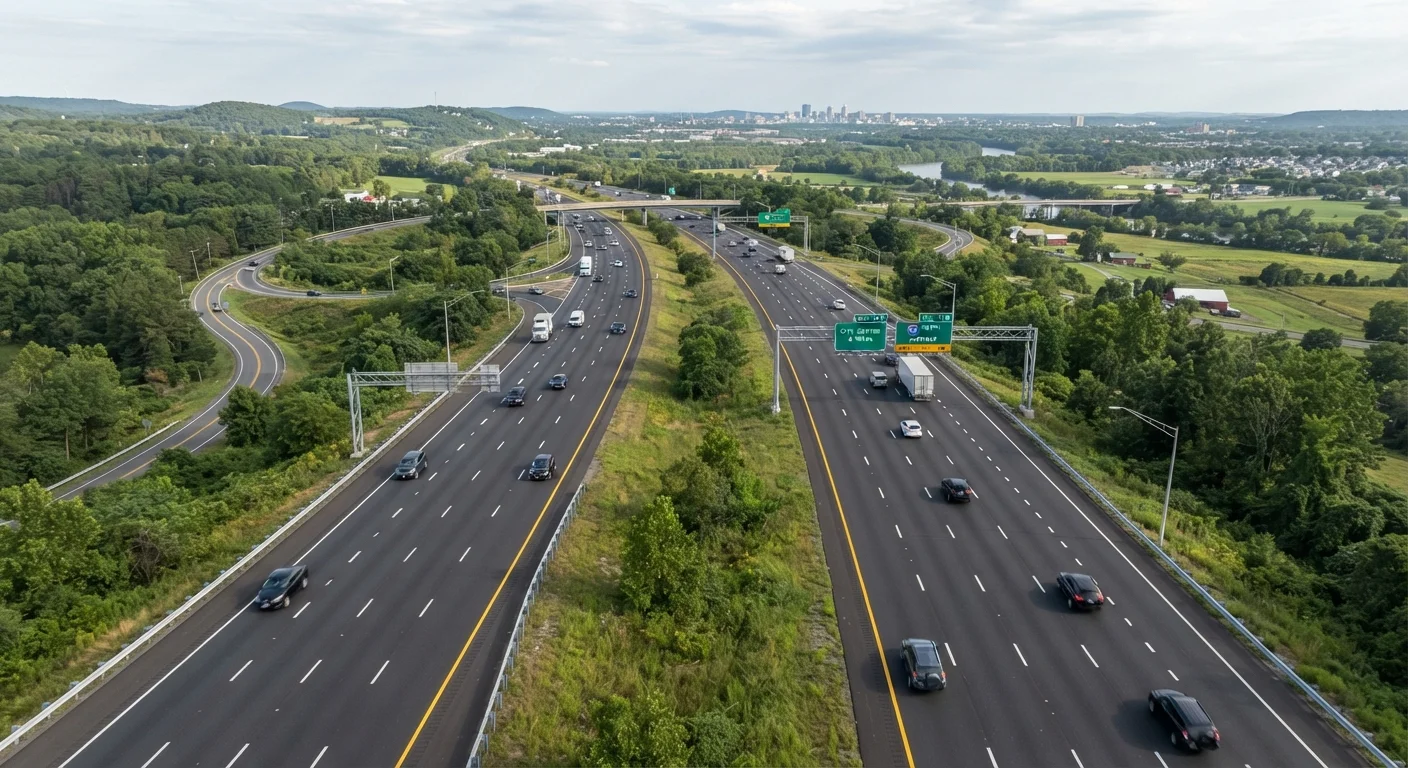


Why Motorways Feel Different
Even confident town drivers feel a jolt of anxiety the first time they approach a motorway on-ramp alone. That reaction is rational. Everything about a motorway is compressed: decisions arrive faster, gaps in traffic close more quickly, and the consequences of misjudgement are more severe than on a 30 mph residential road.
The key shift is thinking further ahead. On slower roads, your attention can stay close to the bonnet. At motorway speed - typically 60-70 mph - you are covering roughly 30 metres every second. Useful observation has to stretch hundreds of metres ahead, not tens.
Speed itself is rarely the problem. What trips up new motorway drivers is the mental load: processing gantry signs, monitoring mirrors, planning lane changes, and watching for brake lights simultaneously. That load reduces with experience, but it helps to understand what you're managing before you set off.
Slip road
A short acceleration or deceleration lane used to join or leave the motorway without disrupting the flow of through traffic.
Hard shoulder
A paved strip running along the left edge of a motorway, reserved for genuine emergencies and breakdowns - not for stopping unless unavoidable.
Gantry sign
An overhead sign spanning the carriageway that displays variable speed limits, lane closures, and warnings. Speed limits shown in red circles are legally binding.
Emergency refuge area (ERA)
A marked lay-by on all-lane-running smart motorways that replaces the traditional hard shoulder as a place to stop in an emergency.
Middle-lane hogging
The practice of staying in the middle lane when the left lane is clear, which is an offence under the UK Highway Code and similar rules elsewhere.
Two-second rule
A method for judging safe following distance: choose a fixed point ahead and ensure at least two seconds pass between the vehicle in front reaching it and your vehicle reaching it.
Before any long motorway trip, run through a basic vehicle check. Our guide to pre-drive safety checks covers the essentials - tyres, lights, fluids - so a mechanical issue doesn't catch you out at speed.
Joining and Leaving: The Slip Road Explained
The slip road is the acceleration lane connecting ordinary roads to the motorway carriageway. Its purpose is to give you space to build speed before you merge - not to wait and then pull out slowly in front of faster traffic.
The practical approach:
- Accelerate early. Begin building speed as soon as you enter the slip road. Aim to be close to motorway traffic speed before you reach the merge point.
- Check your mirrors and blind spot. Look for a suitable gap in the left lane well before the road narrows.
- Signal and merge smoothly. Move into the gap at a matching speed. Drivers already on the motorway do not have to give way to you, though many will adjust to help.
- Don't stop on the slip road unless traffic is completely stationary - stopping forces the drivers behind you to brake suddenly in a merging zone.
Leaving is simpler but has its own trap: missing your exit. If you do miss it, do not reverse on the motorway - continue to the next exit. Plan exits in advance by watching distance markers (one mile, half mile) so you can move to the left lane early rather than cutting across lanes at the last moment.
Understanding road markings helps enormously here. See our explainer on what road lines mean for the markings you'll encounter on and around slip roads.
Lane Discipline and the Rules That Catch People Out
On a three-lane motorway, lanes have defined purposes. Lane 1 (left) is the driving lane - where you should be when not overtaking. Lane 2 (middle) is for overtaking lane-1 vehicles. Lane 3 (right) is for overtaking lane-2 vehicles. Once you've passed, move back left promptly.
Middle-lane hogging - sitting in lane 2 when lane 1 is clear - is one of the most common motorway errors. In the UK it is a specific Highway Code offence (rule 264) carrying a fixed penalty. In the US, many states have similar 'keep right except to pass' laws. Beyond legality, it forces other drivers into unnecessary manoeuvres and degrades traffic flow.
Use Your Mirrors in a Sequence
Before any lane change on the motorway, use the mirror-signal-manoeuvre routine and add a deliberate blind-spot check by glancing over your shoulder. Mirrors alone won't show vehicles in your blind spot, especially motorcycles and smaller cars. Make this check a fixed habit, not an occasional one.
Overtaking on the left (known as 'undertaking' in the UK) is generally illegal and hazardous. If a driver ahead is hogging a lane, you pass on the right. See our detailed breakdown of overtaking rules for grey areas, including when brief undertaking may be unavoidable in slow-moving traffic.
Following distance is the other discipline most new motorway drivers underestimate. Use the two-second rule as a minimum: pick a fixed point ahead, and ensure at least two seconds pass between the vehicle in front crossing it and your vehicle reaching it. In wet conditions, double that gap.
Smart Motorways: What Every Driver Needs to Know
Smart motorways use technology - variable speed limit signs on overhead gantries, sensors, and cameras - to manage traffic flow dynamically. You will encounter them increasingly on major UK routes. There are three main types:
- Controlled motorways: Three or more lanes with variable speed limits displayed on overhead signs. A permanent hard shoulder is retained.
- Dynamic hard shoulder (DHS): The hard shoulder opens as a running lane during busy periods, signalled by gantry signs. When not open, it is for emergencies only.
- All-lane running (ALR): The hard shoulder is permanently removed and replaced by a fourth running lane. Emergency refuge areas (ERAs) are placed at intervals instead.
The rules you must apply on any smart motorway:
- Obey gantry speed limits. Variable limits (shown in red circles) are legally enforceable and camera-monitored. The national speed limit applies when gantries are blank.
- Never drive under a red X. A red X means the lane is closed - no exceptions. Cameras enforce this automatically.
- Know where ERAs are. On ALR motorways, these blue-marked bays replace the hard shoulder. If you feel something is wrong with your vehicle, aim for the next ERA rather than stopping in a live lane.
Smart motorways have been a subject of public and parliamentary debate regarding safety, particularly on all-lane-running sections. Authorities continue to review and update guidance, so checking current official sources before driving a new route is worthwhile.
Breakdowns and Emergencies at Motorway Speed
A breakdown on the motorway is stressful, but a clear sequence of actions makes it safer. If you feel or hear something wrong:
- Signal left immediately and begin moving to the nearside as calmly as traffic allows.
- Reach the hard shoulder or ERA - pull as far left as possible, ideally with wheels turned left toward the verge.
- Switch on hazard lights the moment you stop.
- Exit via the nearside (left/passenger) door and move behind the barrier or up the bank, away from traffic.
- Call for assistance from a safe distance. Do not attempt repairs on the carriageway.
On an ALR smart motorway without a hard shoulder, stopping in a live lane is a last resort. If you cannot reach an ERA, stay in your vehicle with your seatbelt on, hazard lights running, and call emergency services immediately - being struck from behind while stationary is the primary risk, and the vehicle provides some protection.
Preparation reduces breakdown risk significantly. Checking your vehicle before departure - particularly tyre pressures and fuel level - is the simplest way to avoid finding yourself in this situation. For adverse-weather trips, the adjustments covered in our guide to driving in rain, ice, and fog are equally relevant at motorway speeds.