
Why Adverse Conditions Demand a Different Approach
Most drivers learn the basics in fair weather, which means wet roads, ice, and fog expose the gaps in everyday technique. These conditions don't just make driving uncomfortable - they fundamentally change the physics of vehicle control. Traction drops, visibility shrinks, and your margin for error collapses. Adapting your technique isn't optional; it's what separates a close call from a collision.
The core principle across all adverse conditions is the same: create more time and space between your decisions and their consequences. That means slower speeds, longer gaps, and gentler inputs. What changes is how you apply that principle for each specific hazard.
Before you even get in the car, it's worth ensuring your vehicle is prepared. Our guide on seasonal car maintenance covers the checks - from tire tread to wiper condition - that directly affect how well your car handles in poor weather.
Good Technique Starts With a Well-Maintained Car
Tires, wipers, brakes, and lights are the physical foundation of safe adverse-weather driving. Even the best technique is limited by worn tires or faulty brake fluid. Review essential fluid checks as part of your regular maintenance routine.
Driving in Rain: Grip, Aquaplaning, and Distance
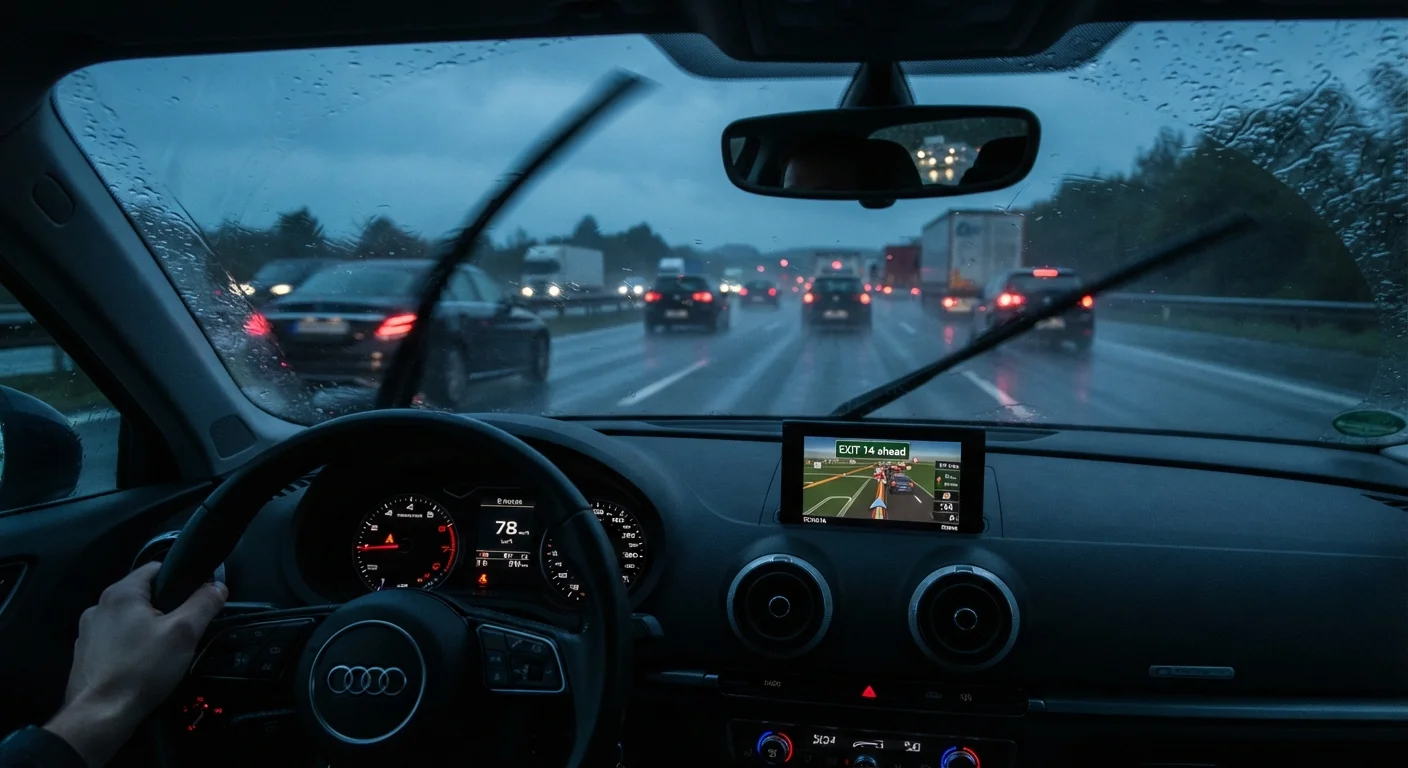
Water between your tires and the road reduces friction. Even moderate rain can cut available grip by 30-50%, and the first 20 minutes of rainfall are often the most dangerous - oil residue rises to the surface before being washed away. Reduce your speed by at least 5-10 mph below the posted limit in steady rain, and more in heavy downpours.
Aquaplaning (also called hydroplaning) occurs when your tires ride on a film of water rather than gripping the road surface. If it happens, ease off the accelerator smoothly - do not brake sharply or turn the wheel. Allow the car to slow naturally until you feel grip return.
Following distance is critical. On dry roads the two-second rule is a minimum; in rain, extend that to at least four seconds. For a fuller explanation of why gaps matter so much, see our article on following distance.
Use dipped (low-beam) headlights in rain, even during daylight - it helps other drivers see you. Avoid cruise control in wet conditions; you need the ability to lift off the throttle instantly.
Driving on Ice: The Art of Doing Less
Ice is the most unforgiving surface you'll encounter. Stopping distances on ice can be up to ten times longer than on dry asphalt at the same speed. Black ice - a thin, transparent glaze - is particularly dangerous because it looks like wet pavement. If the air temperature is near or below freezing and the road surface appears wet and shiny, treat it as potentially icy.
Black Ice Gives No Warning
Bridge decks, overpasses, and shaded road sections freeze before the surrounding road. If the temperature is near or below 32°F (0°C) and the road surface looks wet and glossy, assume ice is present. Reduce speed and avoid any sudden steering or braking inputs until you are confident the surface is clear.
The technique on ice is essentially about minimising inputs: accelerate gently, brake early and softly, and steer with small, deliberate movements. Abrupt actions transfer weight sharply and break traction. If your car begins to slide, steer in the direction you want the front of the car to go (into the slide) and release the throttle - do not stamp the brake.
Anti-lock braking systems (ABS) help maintain steering control under hard braking on slippery surfaces, but they don't shorten stopping distance on ice significantly. Maintain a gap of at least eight to ten seconds behind the vehicle in front. On hills, avoid stopping mid-slope if possible - regaining momentum on ice is difficult. Approach inclines with steady momentum rather than accelerating partway up.
Driving in Fog: Visibility, Lights, and Speed
Fog is deceptive. Drivers consistently overestimate how far they can see in foggy conditions, and they frequently travel faster than their stopping distance allows - a pattern sometimes called overdriving your visibility. The rule is simple: you must be able to stop within the distance you can see clearly.
Light selection matters enormously. Use low-beam headlights in fog - high beams reflect off the moisture particles and actually reduce your forward visibility. If your vehicle has dedicated front fog lights, use them. Activate your rear fog light so vehicles behind can see you, but switch it off when visibility improves to avoid dazzling following drivers.
In dense fog, open your window slightly at junctions and slow-speed manoeuvres - you may hear approaching traffic before you see it. Increase your following distance to at least four to five seconds, and be prepared to reduce speed further as fog thickens without warning. Avoid stopping on the road if possible; if you must pull over, get as far off the travel lane as safely possible and switch on your hazard lights.
The broader habits behind fog driving - anticipating what you can't yet see, scanning further ahead, managing visibility systematically - are core to defensive driving. That mindset is worth building in any condition.
Step-by-Step: Adjusting Your Technique Before and During the Drive
Applying these principles consistently takes deliberate practice. The steps below walk through a reliable pre-drive and in-drive routine for adverse weather conditions.
Check Your Vehicle Before Setting Off
Confirm wipers clear the windshield cleanly and washer fluid is topped up. Verify all lights - headlights, rear lights, and fog lights - are functioning. Check tire tread depth: the legal minimum in the US varies by state, but most safety guidelines recommend at least 4/32" for wet-weather grip and more for snow. Ensure mirrors are correctly positioned to minimise blind spots - see how to set your mirrors correctly if you're unsure.
Reduce Speed Before You Enter the Hazardous Area
Don't wait until you're already on a wet or icy stretch to start slowing down. Reduce speed in advance so you arrive at the hazardous surface with appropriate momentum. On motorways or dual carriageways, signal and move to a less-trafficked lane if safely possible, reducing the pressure to match surrounding speeds.
Set Your Lights Correctly for the Condition
Rain and poor daylight: switch on dipped headlights. Fog: use dipped headlights plus front fog lights if fitted; activate the rear fog light. Ice with clear visibility: dipped headlights are still advisable during daylight for conspicuity. Switch off rear fog lights once visibility exceeds roughly 100 metres to avoid masking your brake lights to drivers behind.
Extend Your Following Distance
In rain: apply a minimum four-second gap. In fog: four to five seconds, adjusted for visibility. On ice: eight to ten seconds minimum. Count the gap by choosing a fixed point - a road sign or bridge - and counting the seconds between when the vehicle ahead passes it and when you do. Adjust continuously as traffic conditions change.
Use Smooth, Progressive Inputs Throughout
Steer, brake, and accelerate gradually. On slippery surfaces, sudden inputs shift vehicle weight abruptly, causing skids. Accelerate slowly from stops, brake earlier than you think necessary, and make lane changes with wide, gentle arcs. On ice especially, the throttle and brake should feel like dimmer switches - not on/off toggles.
Stay Alert to Changing Conditions Mid-Journey
Conditions rarely stay constant. A dry stretch can give way to black ice in a shaded area; fog can thicken around a valley. Scan ahead continuously, watch for brake lights further up the road as an early warning, and be willing to pull over safely if conditions deteriorate beyond your comfort level. No journey is urgent enough to override safety judgment.
For additional visibility checks relevant to all low-light and poor-weather driving, our guide to night driving technique covers complementary habits worth adopting alongside those above.