
Why Following Distance Is More Than a Courtesy
Most drivers understand, at least in principle, that tailgating is dangerous. Yet rear-end collisions remain among the most frequently reported crash types on U.S. roads, and following too closely is consistently cited as a contributing factor. The reason is partly perceptual: the gap that feels adequate from behind the wheel is often far smaller than it needs to be.
Following distance isn't about being polite to the driver ahead. It's a physical buffer that gives you time to perceive a hazard, decide to brake, and actually stop - before hitting anything. These three steps - perception, reaction, and braking - all consume distance, and they happen in sequence, not simultaneously.
Understanding how that sequence works changes how you think about the space in front of your car. See how this concept fits into broader defensive driving principles - anticipating hazards rather than simply responding to them.
~29%
Of all U.S. crashes are rear-end collisions
According to the National Highway Traffic Safety Administration (NHTSA), rear-end crashes consistently represent a significant share of all reported traffic collisions.
1.5 sec
Average driver reaction time
Research cited in driver safety literature places average perception-reaction time between 1.5 and 2.5 seconds, varying with alertness and distraction level.
300+ ft
Total stopping distance at 60 mph
Combining average reaction distance and braking distance, a typical passenger vehicle traveling at 60 mph may require more than 300 feet to stop completely on dry pavement.
The Three-Second Rule - and How to Use It
The most widely taught method for judging following distance in the U.S. is the three-second rule. Here's how it works in practice:
- Pick a fixed object ahead - a road sign, a bridge, a painted line.
- When the vehicle in front passes that object, begin counting: one-thousand-one, one-thousand-two, one-thousand-three.
- If your vehicle reaches that same object before you finish counting, you're following too closely.
Three seconds is the recommended minimum under normal conditions - dry roads, good visibility, and alert driving. It's not a comfort zone; it's a floor.
At 60 mph, three seconds of travel equates to roughly 264 feet. That sounds like a lot of space, but it accounts for the fact that perception and reaction time alone can consume 1-1.5 seconds before your foot even touches the brake pedal. Speed amplifies everything: the faster you're moving, the more distance each second of delay represents.
Adjust Your Count for Highway Speeds
At speeds above 60 mph, some safety instructors recommend extending the count to four seconds or more, since each second of travel covers significantly more ground. The three-second rule was designed as a minimum - at freeway speeds, more space is always better. If traffic conditions allow, err on the side of more gap, not less.
When Three Seconds Isn't Enough
The three-second baseline assumes ideal conditions. Several factors require drivers to increase that gap significantly:
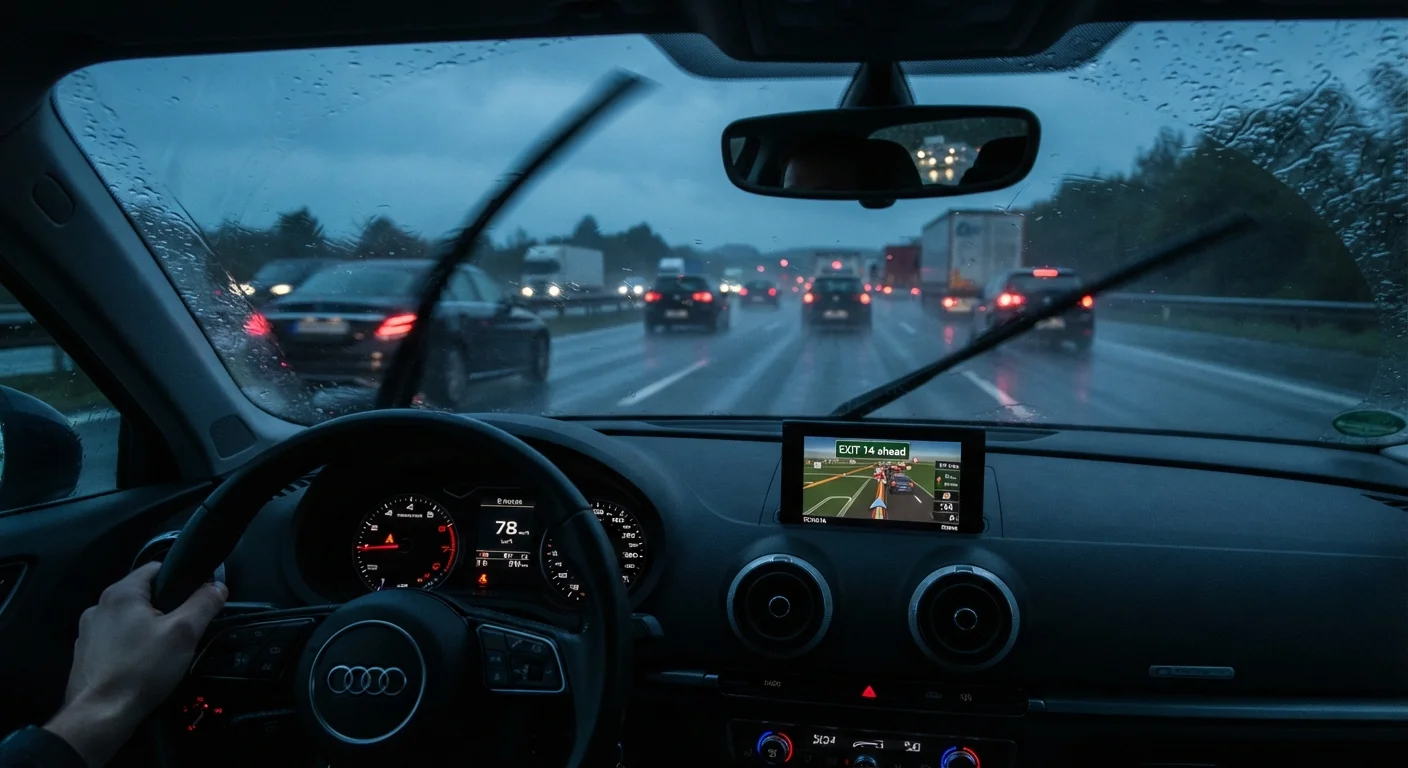
- Wet roads: Water reduces tire traction, which extends stopping distances. Add at least one to two extra seconds in rain.
- Ice or snow: Braking distances can multiply several times over on slick surfaces. A gap of eight to ten seconds may be appropriate.
- Reduced visibility: In fog, heavy rain, or at night, your ability to perceive sudden stops ahead is delayed. More space means more time.
- Large vehicles: If you're following a truck or bus, their stopping distance is longer, and their size obscures what's happening further ahead.
- Fatigue or distraction: Reaction time degrades when you're tired or not fully focused. Distance compensates for slower human responses.
For a full breakdown of how conditions change safe driving technique, see how your technique should change in rain, ice, and fog.
The Hidden Role of Stopping Distance
Many drivers underestimate how much road a vehicle consumes during an emergency stop. Stopping distance has two components:
- Reaction distance
- The distance your vehicle travels from the moment you perceive a hazard until your brakes engage. At an average reaction time of 1.5 seconds, a car traveling at 60 mph covers about 132 feet before braking even starts.
- Braking distance
- The distance needed to come to a full stop once the brakes are applied. This varies by speed, vehicle weight, tire condition, and road surface.
Combined, these figures mean a typical vehicle at 60 mph may need well over 300 feet to stop completely - more than a football field. This is why speed and following distance are inseparable concerns. Even well-maintained vehicles with good tires need significant space to halt safely. Keeping up with regular car maintenance - including brake and tire checks - directly affects your stopping capability.
Tailgating at any speed compresses this margin to nearly zero. It's also worth noting that a driver behind you may not have adequate space either - a reality that reinforces why consistent following distance benefits everyone on the road, not just the driver maintaining it. This pattern of small habits compounding into risk is explored in more depth in habits that quietly erode driver safety over time.
“Space and time are the driver's most important resources. The gap you leave in front of your vehicle is the only cushion you have against the unexpected.”
— National Safety Council, U.S. nonprofit organization focused on eliminating preventable deaths and injuries