

Why This Question Doesn't Have a Simple Answer
The tension between saving and paying off debt is one of the most common financial dilemmas adults face. On the surface, it seems like a math problem - but it's also a risk management decision. The answer shifts depending on several factors: the interest rate on your debt, the size of any existing safety net, the stability of your income, and whether your employer offers retirement contribution matching.
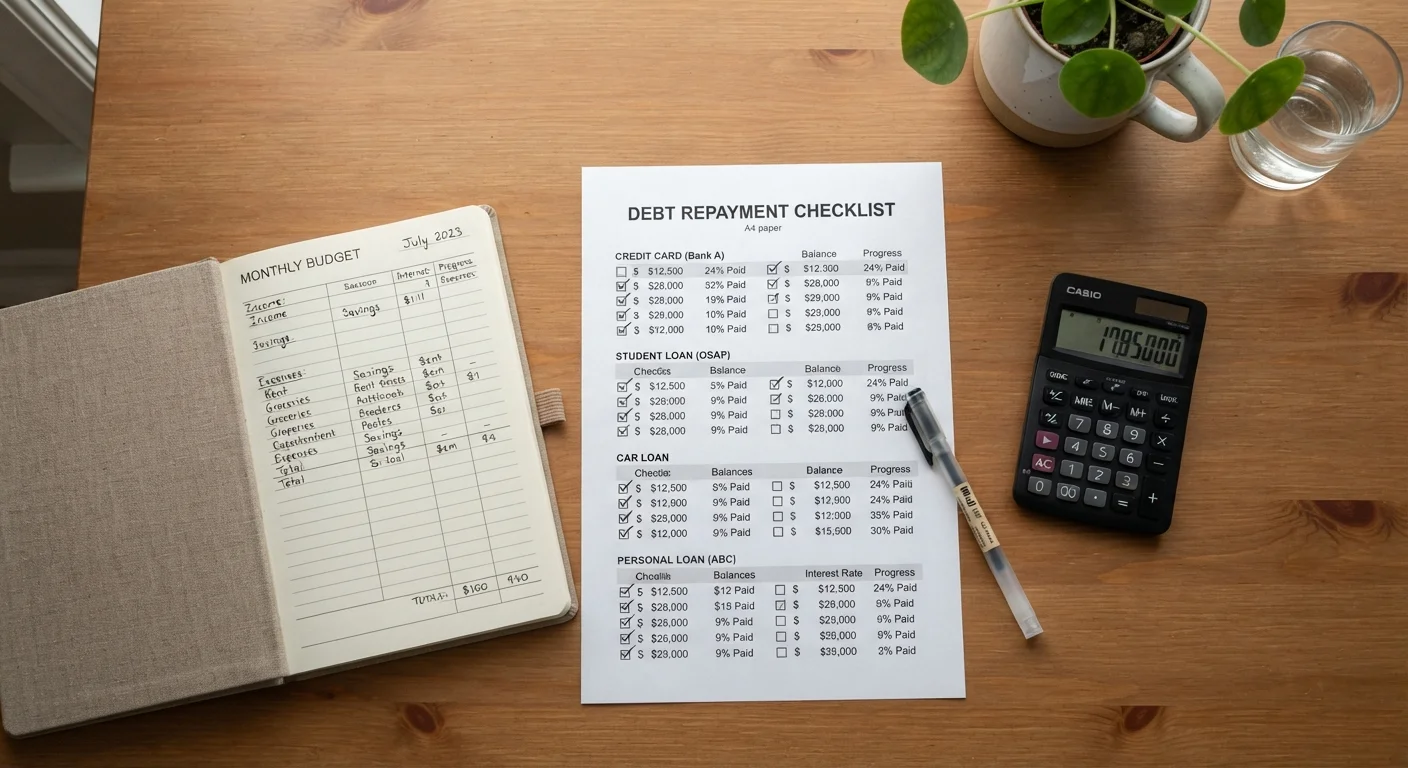
Understanding the general trade-offs - rather than following a rigid rule - gives you the foundation to make an informed choice for your own situation. For a broader framework before diving in, see our debt repayment checklist to ensure any strategy you choose is realistic and complete.
| Prioritize Debt Repayment | Build Emergency Fund First | Split Strategy | |
|---|---|---|---|
| Best interest-rate scenario | High-rate debt (above ~8% APR) | Any rate, no safety net exists | Moderate-rate debt, stable income |
| Risk of new borrowing | Higher without emergency buffer | Lower once fund is established | Balanced with modest buffer |
| Monthly cash flow impact | Maximum freed up long-term | Modest savings build slowly | Divided between both goals |
| Psychological benefit | Debt-free progress motivating | Security reduces financial stress | Balanced, steady forward movement |
| Employer match capture | May be delayed or missed | May be delayed or missed | Can be included alongside |
| Suitable income type | Stable, predictable income | Variable or uncertain income | Either, with proper budgeting |
The Case for Paying Off Debt First
Every dollar sitting in a standard savings account earns interest - but every dollar of high-interest debt also accumulates interest charges. When debt carries a rate significantly higher than what savings can reasonably earn, the arithmetic generally favors repayment first.
For example, credit card debt commonly carries annual percentage rates (APRs) ranging from roughly 20% to 30% or higher. A savings account, even a high-yield one, typically earns far less. Carrying that debt while building savings means you're effectively losing the difference in purchasing power each month.
Beyond the numbers, eliminating debt reduces fixed monthly obligations, which creates more breathing room in your budget over time. Explore frameworks for managing multiple debts if you're juggling several obligations at once.
Start With a Minimum Viable Buffer
If you carry high-interest debt but have no savings at all, consider pausing extra debt payments temporarily to accumulate a small emergency fund - often cited as $500 to $1,000. Once that buffer is in place, redirect all available cash flow toward your highest-cost debt. This sequencing reduces the risk of derailing repayment progress when an unexpected expense arises.
The Case for Building Savings First
Focusing entirely on debt repayment without any emergency reserve is a financially fragile position. If an unexpected expense - a car repair, a medical bill, a period of reduced income - arrives while you have no savings buffer, you may be forced to borrow again, often at high interest. This can create a cycle that erases repayment progress.
Most financial educators recommend establishing a modest emergency fund - often cited as $500 to $1,000 as an initial target - before attacking debt aggressively. This isn't about wealth accumulation; it's about avoiding regression. Once that buffer exists, additional cash flow can be redirected toward debt.
For those starting from scratch, our guide on building an emergency fund on a tight budget offers a realistic, step-by-step approach. And if you're weighing how large your fund ultimately needs to be, three months vs. six months of expenses walks through that decision.
The Hybrid Approach: Doing Both at Once
For many households, an either/or framing is unnecessarily limiting. A split strategy - making minimum required payments on all debts while simultaneously contributing a small amount to savings - addresses both priorities in parallel.
One scenario where this is particularly clear: employer-sponsored retirement accounts with matching contributions. If your employer matches a percentage of your contributions and you're not capturing that match, you're forgoing a guaranteed return on that money. That benefit often outweighs the cost of carrying moderate-interest debt in the short term.
The basics of building a monthly budget can help you identify exactly how much cash flow is available to allocate across competing priorities. Separately, it's worth understanding how the type of debt you carry affects your options - secured vs. unsecured debt have different risk profiles and repayment implications.
~28%
Average credit card APR in the US
The Federal Reserve reported average credit card interest rates above 20% in recent years, with many accounts charging significantly higher rates.
4 in 10
Americans unable to cover a $400 emergency
Federal Reserve surveys have consistently found that a significant share of US adults could not easily cover an unexpected $400 expense without borrowing.
Key Variables That Should Shape Your Decision
Rather than following a universal rule, evaluate these factors for your own situation:
- Interest rate on your debt: Debt above roughly 7-8% APR typically costs more than savings can earn; below that threshold, the calculus becomes less clear-cut.
- Income stability: Variable or uncertain income strengthens the case for a larger emergency cushion before accelerating debt payments.
- Existing safety net: If you have family support or other resources, the urgency of a savings buffer may be lower.
- Debt type: Federal student loans, mortgages, or other lower-rate structured debt may warrant a different approach than high-rate revolving credit.
If your debt involves multiple accounts at varying rates, strategies like the avalanche or snowball methods can help you sequence repayments efficiently - see our comparison of debt avalanche vs. debt snowball for a detailed breakdown. You may also want to review a complete guide to savings and emergency funds for the broader savings context.
This article provides general financial information for educational purposes only and does not constitute personalized financial, investment, tax, or legal advice. Consult a qualified financial professional before making decisions based on your individual circumstances.