
Why Multiple Debts Feel Overwhelming
Carrying debt across several accounts simultaneously - a credit card balance here, a personal loan there, maybe a medical bill or two - creates a particular kind of financial stress. It isn't just the total amount owed; it's the competing due dates, differing interest rates, and the mental load of tracking them all at once.
Research in behavioral economics consistently finds that complexity itself discourages action. When people don't know where to start, they often don't start at all. That inertia is expensive: interest compounds daily on most consumer debt, meaning delay has a real, measurable cost.
If you're new to thinking about debt systematically, this foundational overview can ground you in the basics before diving into strategy. The goal here is to cut through the noise and give you a framework for making decisions - not a one-size-fits-all prescription.
Taking Stock: Building Your Complete Debt Picture
No repayment strategy works without accurate inputs. Before you prioritize anything, gather the following for every debt you carry:
- Current balance - the exact amount owed today, not when you last checked
- Interest rate (APR) - the annual percentage rate, including any promotional or penalty rates
- Minimum monthly payment - what you're contractually required to pay
- Debt type - secured (mortgage, auto loan) vs. unsecured (credit card, personal loan)
- Account status - current, delinquent, or in collections
Lay this out in a single document - a spreadsheet works well. The total may feel uncomfortable to look at, but visibility is the precondition for control. You cannot prioritize what you haven't measured.
~$7,200
Average US household credit card balance
According to Federal Reserve and industry survey data, the average revolving credit card balance per US household has consistently exceeded $7,000 in recent years.
20-30%+
Typical credit card APR range
The Consumer Financial Protection Bureau has documented average credit card APRs at or above 20% in recent periods, with penalty rates often exceeding 29%.
2-3x
Cost multiplier of minimum-only payments
Consumer finance research consistently shows that paying only minimums on a high-rate credit card can result in repaying two to three times the original balance in total.
Once you have a full picture, you're positioned to apply a repayment framework deliberately rather than reactively. Pair this exercise with a review of your monthly cash flow - the budgeting basics hub offers practical tools for understanding what you actually have available after essential expenses.
Repayment Frameworks: Avalanche, Snowball, and Hybrid
Two evidence-discussed methods dominate personal finance guidance for multi-debt repayment:
The Avalanche Method
Direct any extra payment capacity toward the debt with the highest interest rate first, while maintaining minimums on all others. Once that balance reaches zero, redirect the freed-up payment to the next-highest-rate debt. This approach minimizes total interest paid over time and is mathematically optimal for most situations.
The Snowball Method
Target the smallest balance first regardless of interest rate, then roll that freed payment into the next-smallest. The appeal is behavioral: eliminating accounts creates tangible wins that sustain motivation. Studies have suggested that for some individuals, the psychological reinforcement improves follow-through, even if the total interest cost is somewhat higher.
Hybrid Approaches
Some people start with the snowball to build momentum, then switch to the avalanche once they've cleared one or two smaller accounts. Others prioritize accounts with particular consequences - a card near its credit limit hurting their credit utilization, for example. There is no universally correct answer; the strategy you consistently execute outperforms the optimal strategy you abandon.
List your debts sorted by interest rate in one column and by balance in another before choosing a method. Seeing both orderings side by side helps you make an informed, conscious choice rather than defaulting to habit.
Many people pick a repayment method arbitrarily or based on incomplete information. A side-by-side comparison makes the trade-offs between cost and motivation concrete and visible.
Set up automatic minimum payments on every account the day you implement a new strategy - even if you plan to overpay several of them. Missing a minimum while focusing extra funds elsewhere can trigger a late fee or penalty rate that erases your progress.
Penalty APRs can be triggered by a single missed payment and may apply to the entire existing balance, significantly increasing the cost of the debt.
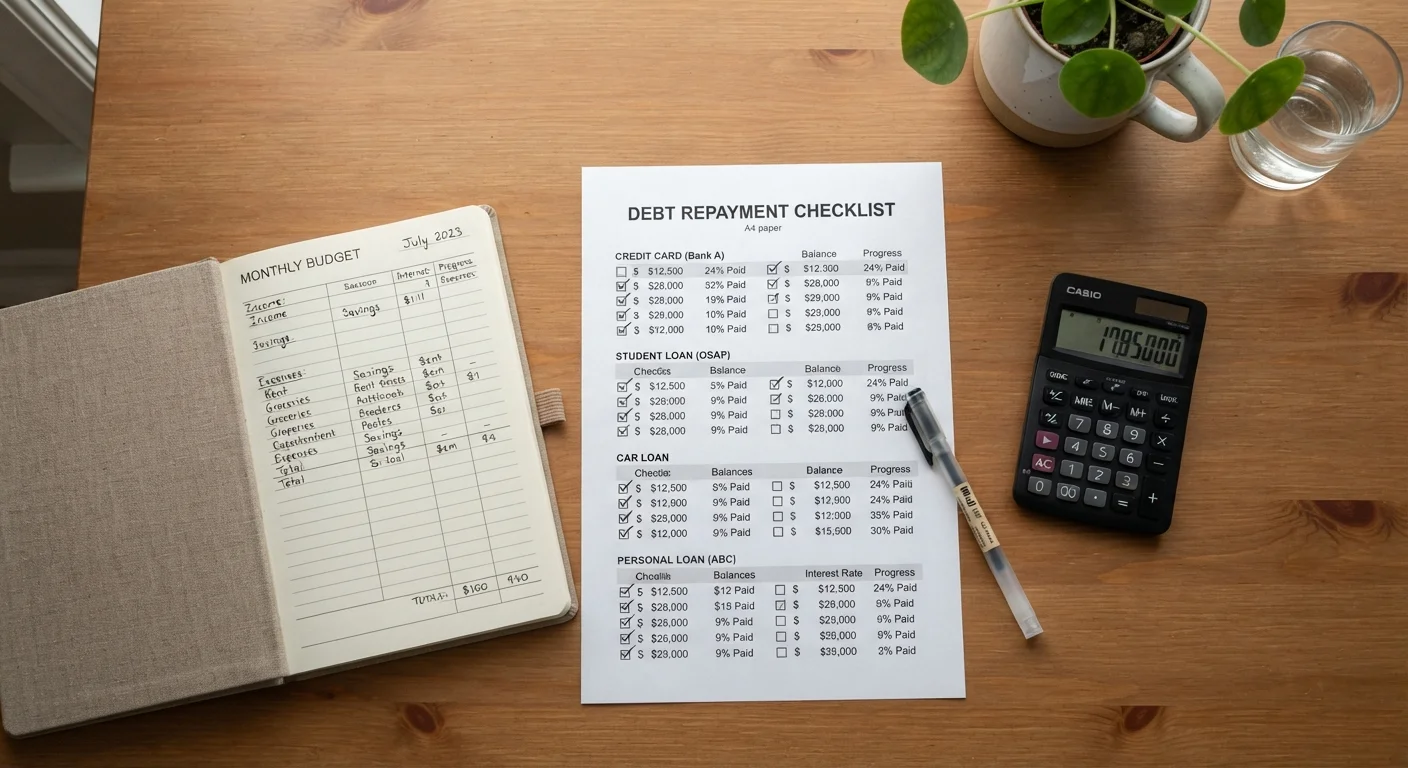
Before committing to any framework, run through the debt repayment plan checklist to confirm your chosen approach is realistic given your actual cash flow.
How to Prioritize When Not All Debts Are Equal
Interest rate isn't the only axis that matters. Some debts carry consequences that go beyond cost:
- Secured debts (mortgage, car loan) - missing payments risks losing the underlying asset. These generally demand minimum payments first, no matter what else is happening.
- High-APR revolving debt (many credit cards) - rates commonly range from 20% to 30%+ APR, meaning interest accrues rapidly and can outpace any repayment effort if only minimums are paid.
- Federal student loans - typically carry lower rates and flexible income-driven repayment options; aggressive extra payments may be lower priority than high-rate consumer debt.
- Medical debt - often negotiable and, in many cases, reported to credit bureaus differently than revolving debt. Engaging the provider or billing department early can change the picture.
- Debts in collections - these require distinct handling. Understanding what collections status actually means for your credit and your legal rights is essential before making any payments.
One open question many people face: should you aggressively pay down debt or build savings simultaneously? That trade-off has real nuance - the saving vs. paying off debt guide walks through the key considerations.
Common Pitfalls to Avoid
Even well-intentioned debt management can go sideways. Watch for these patterns:
- Paying only minimums across all accounts - minimums are designed to keep accounts current, not to meaningfully reduce principal. On high-rate balances, minimum-only payments can extend repayment by years and multiply total interest paid.
- Opening new credit to manage existing debt without a clear plan - balance transfer cards and debt consolidation loans can reduce interest costs, but they require discipline. Transferring a balance and then continuing to charge the original card compounds the problem.
- Ignoring smaller debts entirely - a forgotten $200 medical bill that goes to collections can affect your credit report for years. Small doesn't mean inconsequential.
- Treating tax debt like ordinary consumer debt - the IRS and state tax agencies have collection powers (wage garnishment, liens) that most private creditors don't. Tax debt generally warrants early, direct engagement with the relevant agency.
- Stopping contributions to employer-matched retirement accounts - if your employer matches contributions, pausing them to pay debt faster means forfeiting guaranteed returns. In many cases, even modest debt paydown doesn't offset that loss. Consult a financial professional for your specific situation.
When to Consider Outside Help
There's no shame in recognizing when the complexity exceeds what self-management can reasonably handle. Several legitimate avenues exist:
Nonprofit credit counseling agencies - accredited by organizations such as the National Foundation for Credit Counseling (NFCC), these agencies offer free or low-cost budget counseling and, where appropriate, structured debt management plans (DMPs) that may reduce interest rates through agreements with creditors.
Licensed financial advisors - particularly useful if your situation involves significant assets, tax implications, or intersecting goals like retirement saving and debt repayment running simultaneously.
Bankruptcy counsel - an attorney specializing in consumer bankruptcy can explain whether Chapter 7 or Chapter 13 makes sense for your circumstances. Bankruptcy has serious, lasting credit implications and isn't a first resort, but for some situations it provides a legal path to resolution that self-repayment cannot.
Be cautious of for-profit debt settlement companies that promise to negotiate balances for a fee. These arrangements carry significant risks, including damage to your credit and the possibility of lawsuits from creditors during the negotiation period. Verify any third party through your state attorney general's office or the Consumer Financial Protection Bureau (CFPB) before engaging.
Managing multiple debts is rarely a quick fix - it's a sustained process that benefits from clarity, consistency, and periodic reassessment as balances shift and circumstances change. The saving and emergency funds hub is a useful companion resource as you work to stabilize your financial position alongside debt reduction.
This article is for general informational and educational purposes only. It does not constitute personalized financial, legal, or tax advice. Consult a qualified financial professional for guidance tailored to your individual circumstances.