
What the One-In-One-Out Rule Actually Is
The one-in-one-out rule is straightforward in theory: whenever a new item enters your home, one existing item must leave. Bring in a new sweater, donate an old one. Buy a kitchen gadget, pass on the one it replaces. The appeal is obvious - it creates a natural ceiling on how much you own, without requiring dramatic purges.
But like many organizing principles, it looks cleaner on paper than in practice. Real homes involve gifts, impulse purchases, shared spaces, and emotional attachments that the rule doesn't account for by default. Understanding where the rule holds up - and where it quietly breaks down - is the difference between a system that works and one that gets abandoned after three weeks.
For context on how one-in-one-out fits alongside other organizing philosophies, see Organizing Approaches Worth Knowing for a grounded comparison.
Common Myths About the Rule - and What's Actually True
Misconceptions about the one-in-one-out rule often cause people either to abandon it too quickly or to apply it in ways that don't serve them. The myth-fact breakdown below addresses the most persistent misunderstandings.
Myth
The one-in-one-out rule will declutter your home on its own.
Fact
The rule maintains a level of ownership - it doesn't reduce it. Decluttering must come first.
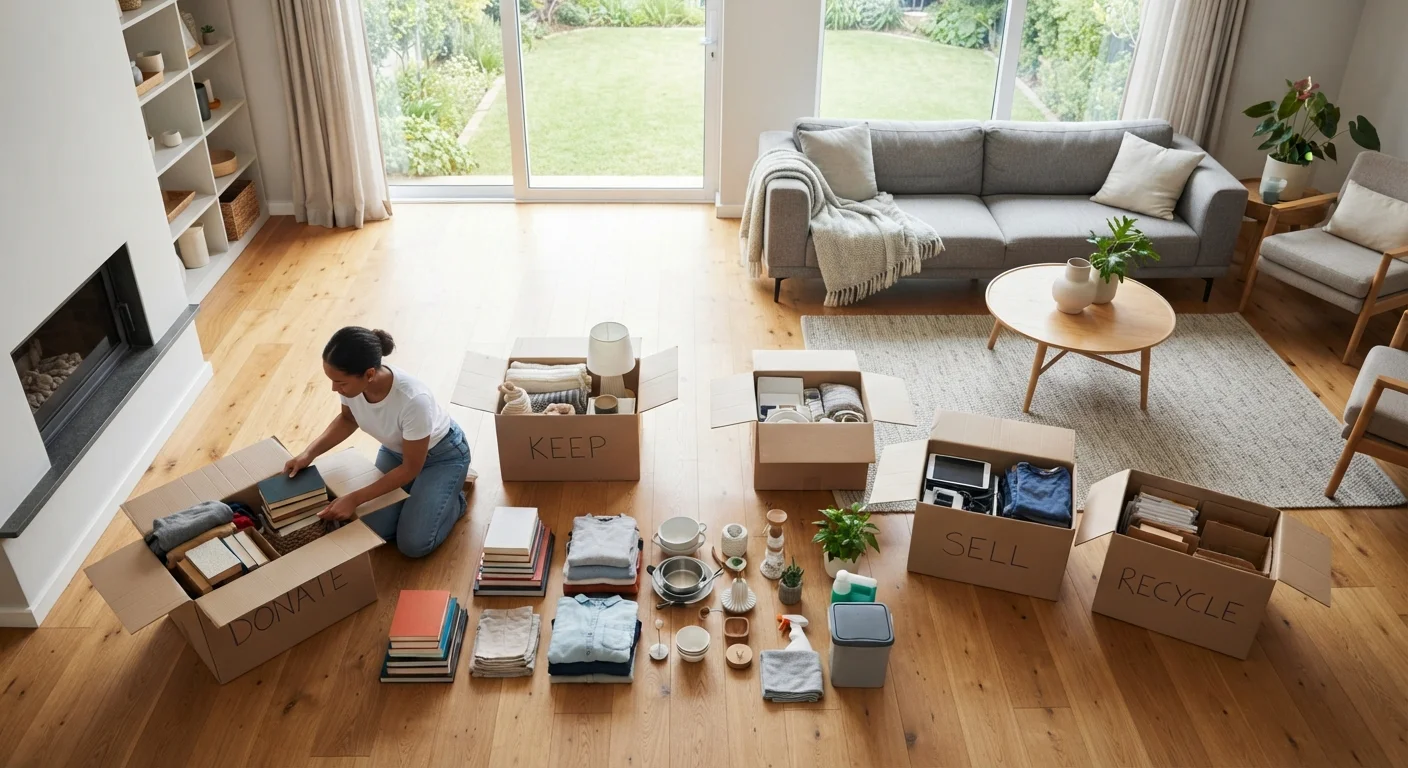
If you already own more than feels manageable, adding the one-in-one-out rule without first paring down simply freezes the problem in place. Think of it as a lid, not a drain. An initial decluttering pass - even a modest one room at a time - creates the baseline the rule is designed to protect. See what excess ownership actually costs for motivation to make that first pass count.
Myth
The rule works equally well across every category of item.
Fact
Consumables, sentimental items, and gifts require different handling than everyday goods.
Toothbrushes and kitchen sponges replace themselves through use - applying one-in-one-out to consumables adds friction without benefit. Sentimental items carry emotional weight that makes strict one-for-one swaps feel punitive and unsustainable. The rule is most effective for durable, recurring categories: clothing, books, tools, décor, and hobby supplies, where accumulation is steady and decisions are more neutral.
Myth
If you slip up once, the system stops working.
Fact
Occasional exceptions don't break the rule; they're a normal part of any long-term habit.
Organizing systems fail not because of individual lapses but because people abandon the habit after a lapse. Research on behavior change suggests that treating a missed instance as a temporary pause - rather than a system failure - leads to far better long-term adherence. Building in a short catch-up window (say, reviewing outgoing items at the end of each month) prevents small slips from snowballing.
Myth
One-in-one-out means you can buy whatever you want, consequence-free.
Fact
The rule limits volume, not spending - and doesn't account for quality, cost, or necessity.
The rule is a volume control tool. It doesn't evaluate whether a new purchase is worth making, well-made, or genuinely needed. Applied without judgment, it can actually encourage unnecessary purchases by framing them as automatically offset. Pairing one-in-one-out with a brief pause before buying - asking whether the item solves a real problem - keeps both volume and spending in check.
Myth
The rule is only useful for minimalists or people who already own very little.
Fact
The rule scales to any household size and works best precisely when ownership feels like too much.
One-in-one-out is not an identity statement about minimalism. It's a mechanical ceiling on accumulation, adaptable to households of any size, lifestyle, or budget. Families with children can apply it per person or per category. Hobbyists can apply it within a designated storage area. The principle bends to fit real life - as long as it's applied consistently enough to create a pattern.
25%
Of two-car garages that can't fit a car
According to a U.S. Department of Energy estimate, roughly one in four two-car garages is too full of stored items to accommodate vehicles - illustrating how accumulation outpaces available space over time.
80%
Of clutter items never used again
Professional organizers frequently cite research suggesting the vast majority of items people hesitate to discard are never returned to - underscoring why a volume-limiting rule like one-in-one-out matters.
Where the Rule Breaks Down - and How to Fix It
The rule's most common failure point is timing: many people try to use it as a substitute for initial decluttering, when their starting point is already overcrowded. One-in-one-out maintains a baseline - it can't create one. Before applying the rule, it helps to establish what a comfortable, functional level of ownership looks like for each category in your home.
A structured room audit checklist can surface what you actually use and what's simply taking up space, giving you a realistic baseline to maintain.
The rule also struggles with shared households. If one person applies it diligently and another doesn't, the system erodes. In these cases, applying the rule by designated spaces - your closet, your nightstand - rather than the whole home can preserve its usefulness without creating household friction.
Don't Skip the Baseline Step
Applying one-in-one-out to an already-overcrowded home can create a false sense of progress without reducing clutter. Before relying on the rule for maintenance, do at least one deliberate pass through each category to reach a comfortable baseline. Skipping this step is the most common reason the rule feels ineffective within the first month.
Finally, seasonal and gift influxes tend to break the rule's rhythm. Setting a soft window - within two weeks of a gift or purchase, identify the corresponding outgoing item - keeps the habit from stalling without requiring same-day action that feels punitive.
Smarter Ways to Apply It Long-Term
The most durable version of the rule is category-specific rather than home-wide. Clothes, books, kitchen tools, and hobby supplies each have their own accumulation patterns. Applying one-in-one-out per category makes decisions concrete: a new cookbook means selecting one to donate, not scanning the entire house for a sacrifice.
For households prone to re-accumulation, a two-in-one-out variation during initial setup can gradually right-size belongings before switching to maintenance mode. This is especially useful in areas like the garage or storage rooms, where room-by-room organizing strategies can provide a fuller framework.
Understand, too, that the rule is a habit - and habits have off seasons. Missing a week or a month doesn't invalidate the system. What matters is returning to it. Research on habit formation consistently shows that resuming a lapsed habit quickly produces better long-term outcomes than treating a lapse as failure. The patterns that undo organized homes are well-documented; knowing them in advance makes the rule easier to sustain.