
Why Licence Categories Matter
Your driving licence is more than a permission slip - it defines exactly which vehicles you are legally allowed to operate. Drive outside your permitted category, even innocently, and you risk prosecution, a void insurance policy, and penalty points. Yet many drivers never look past their Category B entitlement.
UK driving licences follow a standardised system set out by the Driver and Vehicle Licensing Agency (DVLA). Each alphanumeric code represents a specific class of vehicle, with age requirements, engine restrictions, and in some cases additional tests attached. Getting familiar with these codes puts you firmly in control of what you can and cannot drive.
| Minimum age for Category B (car) | 17 years old (DVLA, UK) |
| Minimum age for unrestricted Category A (motorcycle) | 21 (via A2 progression) or 24 (direct access) (DVLA, UK) |
| Category B MAM limit | 3,500 kg (DVLA, UK) |
| Category B licence renewal age | Age 70, then every 3 years (DVLA, UK) |
| C and D licence renewal schedule | At age 45, then every 5 years (DVLA, UK) |
| Trailer weight requiring Category BE | Over 750 kg where combined weight exceeds 3,500 kg (DVLA, UK) |
For a deeper look at the rules governing everyday driving decisions, see our guide to road markings - another area where assumptions regularly catch drivers out.
Motorcycle and Moped Categories: AM, A1, A2, and A
Two-wheeled categories follow a graduated access system designed to build rider experience progressively before moving to more powerful machines.
MAM (Maximum Authorised Mass)
The maximum weight of a vehicle including its load, as specified by the manufacturer. MAM is the key figure used to determine which licence category applies to a vehicle.
Entitlement
A specific vehicle category you are legally permitted to drive, as recorded on your driving licence. You may hold multiple entitlements simultaneously.
Direct Access Scheme (DAS)
A route allowing riders aged 24 or over to take a motorcycle test on a full-power machine and obtain unrestricted Category A entitlement without progressing through A1 and A2 stages.
Driver CPC
Driver Certificate of Professional Competence - a qualification required for drivers who use C or D category vehicles commercially. It involves an initial qualification and periodic training to maintain.
Photocard Licence
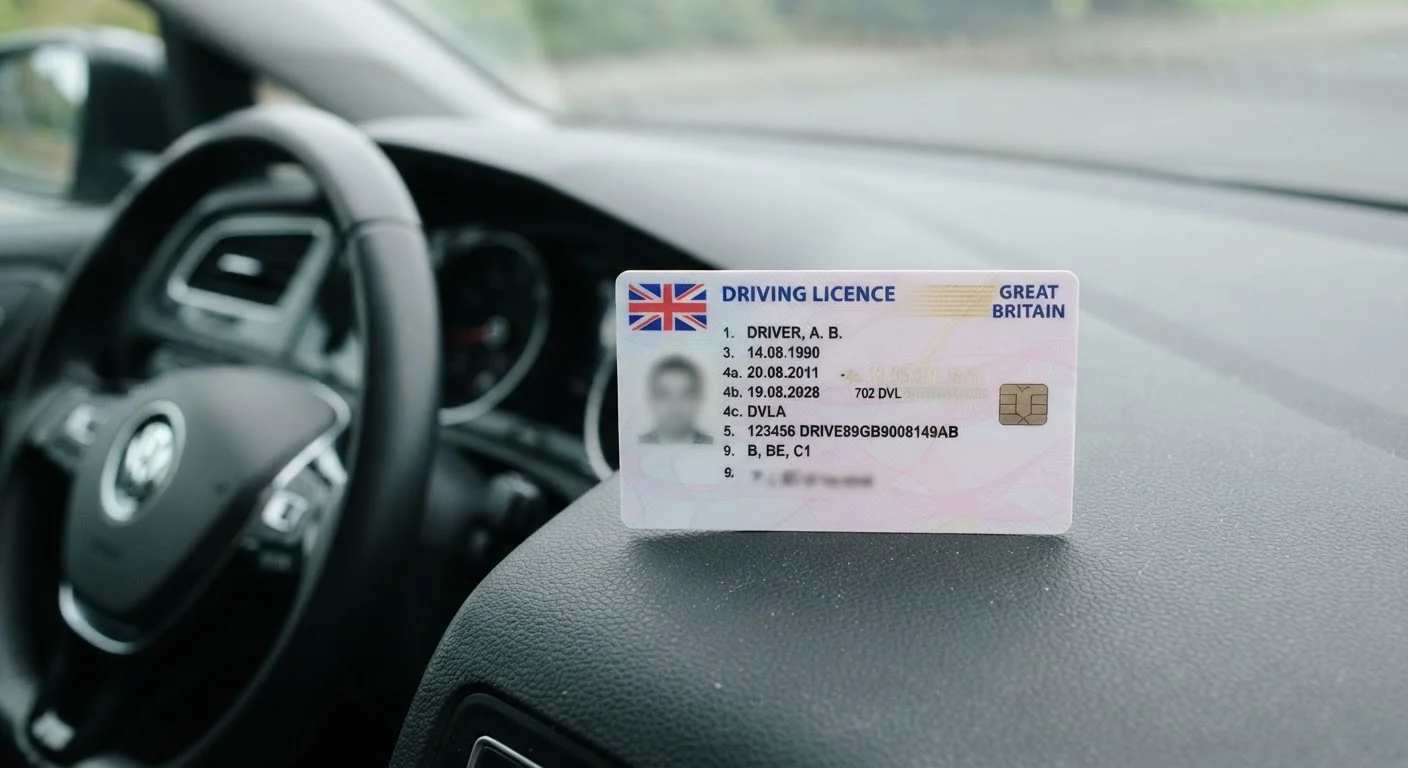
The current format of the UK driving licence, consisting of a credit-card-sized plastic card. The front shows personal details and a photo; the back lists all vehicle category entitlements.
Category BE
The towing entitlement for car drivers needing to tow a trailer when the combined weight of the car and trailer exceeds 3,500 kg. A separate practical test is required to obtain this category.
- Category AM - Mopeds with a maximum speed of 45 km/h (28 mph) and an engine no larger than 50cc. Minimum age: 16.
- Category A1 - Light motorcycles up to 125cc and 11 kW (about 15 bhp). Minimum age: 17. Requires a separate test from Category B.
- Category A2 - Motorcycles up to 35 kW (47 bhp) with a power-to-weight ratio not exceeding 0.2 kW/kg. Minimum age: 19.
- Category A - Unrestricted motorcycle access. Available at age 24 via direct access, or at 21 after holding A2 for two years. Covers all engine sizes including tricycles over 15 kW.
Each step up requires passing a new practical test - simply holding a car licence does not grant motorcycle entitlement.
Car and Light Vehicle Categories: B, B1, and BE
Category B is the licence most UK drivers hold. It covers passenger cars and light vans up to 3,500 kg maximum authorised mass (MAM) with no more than eight passenger seats. If you passed your test after 1 January 1997, you may also drive a vehicle with a trailer, provided the combined weight of vehicle plus trailer does not exceed 3,500 kg - if it does, you need Category BE.
- Category B1 - Motor vehicles with four wheels, typically quadricycles, up to 400 kg unladen (550 kg for freight). This category is rarely issued independently in the UK today.
- Category BE - A Category B vehicle towing a trailer where the combination exceeds 3,500 kg MAM or the trailer exceeds 750 kg. Requires a separate practical test.
Towing rules catch many drivers off guard. If you plan to haul a large caravan or horsebox, verify whether your licence already includes BE or whether you need to sit the additional test before hitching up.
Once you have your B licence, motorways become part of your legal driving environment - though they have their own demands. Our motorway driving guide for first-timers covers everything new drivers need to know before their first solo run.
Medium and Large Vehicle Categories: C, C1, CE, C1E
These categories cover larger goods vehicles and are subject to additional medical standards, Driver Certificate of Professional Competence (CPC) requirements for commercial use, and regular licence renewal.
- Category C1 - Vehicles between 3,500 kg and 7,500 kg MAM. Minimum age: 18. Commonly used for large motorhomes or medium-sized trucks.
- Category C - Any lorry over 3,500 kg with a trailer up to 750 kg. Minimum age: 18 (21 without relevant CPC).
- Category C1E - A C1 vehicle with a trailer over 750 kg, provided the combination does not exceed 12,000 kg MAM.
- Category CE - A Category C vehicle with any trailer. This is the full articulated lorry entitlement.
Holding a Category C licence does not automatically confer passenger-carrying vehicle rights - those require separate D-category entitlement.
Passenger Vehicle Categories: D, D1, DE, and D1E
Passenger-carrying vehicle (PCV) categories cover minibuses and buses. Like the C categories, they carry medical, CPC, and age conditions for professional use.
- Category D1 - Minibuses with between 9 and 16 passenger seats, not for hire or reward (carrying passengers for payment requires CPC). Minimum age: 21.
- Category D - Any bus with more than eight passenger seats. Minimum age: 24 (21 in some CPC training routes).
- Category D1E and DE - The equivalent towing extensions for D1 and D respectively.
Many people who passed their Category B test before 1 January 1997 will find a D1 entitlement already on their licence - a legacy provision allowing driving of minibuses not for hire or reward. Check the back of your photocard licence to confirm what you hold.
Accumulating penalty points can affect any category of entitlement. If you want to understand how that system works, our points on your licence explainer sets out the rules clearly.
Checking and Updating Your Entitlements
The simplest way to see every category on your licence - including any automatic or manual restrictions, corrective lens conditions, or geographic limitations - is to use the DVLA's online 'View driving licence' service at gov.uk. You will need your National Insurance number and licence details to hand.
Entitlements printed on the back of your photocard are coded by category number and accompanied by dates showing when they were granted and when they expire (where applicable). Some categories, such as C and D, must be renewed at age 45 and every five years thereafter; others, like B, run until age 70 for most drivers.
If you are considering expanding your entitlement - whether to tow a heavier trailer, ride a motorcycle, or drive a minibus - the DVLA website lists the required tests, minimum ages, and any medical standards for each category. Knowing your limits now prevents a costly mistake later, including the kind that can show up on your insurance record for years.
This article provides general information about UK driving licence categories and is not a substitute for official DVLA guidance. Always verify your specific entitlements and any legal requirements directly with the DVLA or a qualified driving instructor.