
Why Itinerary Overload Happens to Even Careful Planners
Over-packing an itinerary isn't a sign of poor judgment - it's a predictable result of how most people plan trips. You're sitting at home, researching a destination you've never visited, excited about everything you've read. The planning environment has zero friction: clicking to add another museum or day trip costs nothing. The real costs - time, energy, transit - only appear on the ground.
This disconnect between the planning experience and the travel experience is at the root of most itinerary failures. Add the psychological pull of wanting to justify the expense of the trip, and it's easy to see why travelers default to more rather than less.
Understanding this pattern is the first step. The mistakes that follow - and the ways to fix them - are specific and correctable. For a grounding framework before you start scheduling, see what every solid travel itinerary actually needs.
Don't Mistake Activity Count for Value
Visiting more sites does not automatically make a trip more rewarding. Rushing through eight attractions in a day typically leaves you with surface-level impressions and physical fatigue. Travelers who slow down and engage more deeply with fewer places often report higher satisfaction - and come home with clearer memories.
The Six Mistakes That Overload Your Days
These are the most consistent scheduling errors travelers make - each one looks harmless at the planning stage and becomes costly in the field.
Ignoring transit time between activities.
Why it happens: Maps make distances look deceptively short, and planners often estimate travel time in ideal conditions - no traffic, no wrong turns, no luggage.
Booking timed-entry tickets for back-to-back attractions with no gap between them.
Why it happens: Online booking systems make it easy to stack reservations without visualizing the physical movement required to get from one venue to the next.
Failing to account for meal time as part of the schedule.
Why it happens: Meals feel like a background activity, so planners mentally compress them - assuming 20 minutes when a sit-down lunch in a busy tourist area typically takes 60-90 minutes.
Planning at the same pace every day of the trip.
Why it happens: Itineraries are often built in a single planning session, leading to uniform density across all days without considering that fatigue compounds over time.
Underestimating how long popular attractions actually take.
Why it happens: Guidebooks and travel blogs rarely list realistic time estimates; they describe highlights without conveying crowds, size, or the time needed to genuinely engage with a place.
Applying solo-traveler pacing to a group trip.
Why it happens: The person doing the planning naturally imagines their own pace, forgetting that a group moves at the speed of its slowest or most distracted member.
Over-Planning Has Real Costs
An itinerary stuffed with back-to-back commitments doesn't just cause stress - it can lead to missed bookings, skipped meals, and a trip that feels more like a sprint than a vacation. The consequences are financial as well as experiential: non-refundable tickets and reservations that you never reach because the day fell apart earlier than expected.
How to Recalibrate: Building a Schedule That Holds
The fix for an overpacked itinerary isn't doing less - it's planning more honestly. Start by listing everything you want to do, then cut the list by roughly 30% before you build the daily schedule. What remains should be prioritized by genuine interest, not by a sense of obligation to 'see everything.'
Next, build your days around one or two anchor experiences and treat everything else as optional. If you reach the optional items, that's a bonus. If you don't, the day still succeeded.
Buffer time isn't wasted time. A 45-minute window between activities is your insurance policy against the inevitable: a train that's late, a café line that's longer than expected, a view you want to sit with for ten minutes. Travelers who build this slack into their days consistently report smoother, less stressful trips.
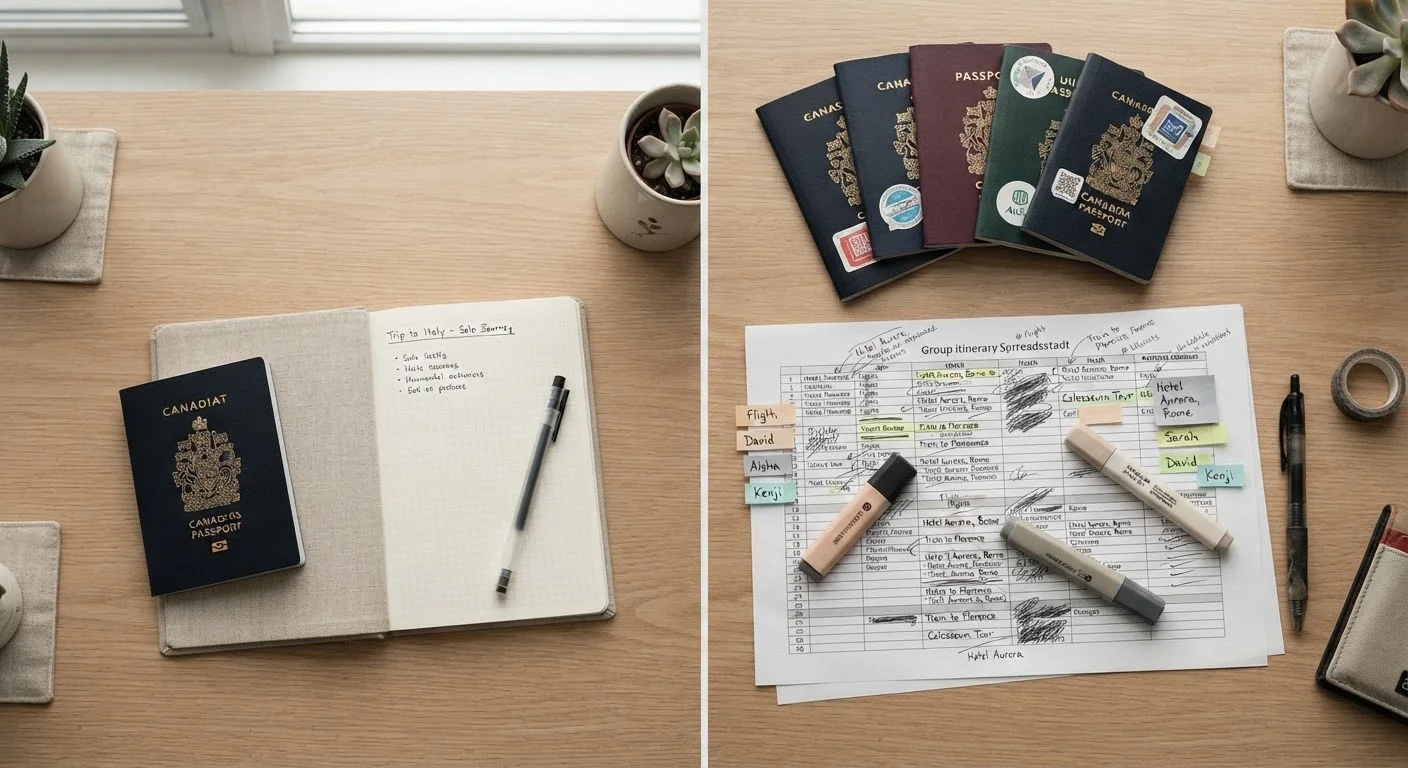
If you're coordinating with others, the calculus changes. Solo and group trip planning differ in fundamental ways - a schedule that works for one person moving efficiently will break down quickly when five people need to agree on where to eat lunch.
For a practical method to sequence activities, rest, and transit into a realistic daily flow, building a trip timeline that holds up from day two onward is the logical next step. And if you're managing multiple destinations in one trip, the added complexity of multi-destination planning deserves separate attention - the margin for error shrinks considerably when transit between cities or countries is involved.
~2 hrs
Average daily time lost to unplanned delays
Travel researchers and trip-planning experts commonly cite transit gaps, queues, and meal overruns as the primary schedule killers on leisure trips.
1 in 3
Travelers who report post-trip burnout
Surveys by travel industry analysts have found a significant share of leisure travelers return home feeling they needed a vacation from their vacation, often citing over-scheduling.