
The Root Problem: Mirrors Set for Comfort, Not Coverage
Ask most drivers why they angle their side mirrors the way they do, and the honest answer is: that's how they've always done it. The instinct to see a wide strip of your own car's door and rear quarter panel in the mirror feels reassuring - it creates a familiar reference point. Unfortunately, that strip of metal is information you already have. What you don't have is a clear view of the lane beside you.
The result is an overlapping blind zone. Your rearview mirror covers the center lane behind you. Your side mirrors, when aimed correctly, should pick up precisely where the rearview mirror leaves off. When they're turned too far inward, both mirrors show the same stretch of road - and the zone alongside your rear doors goes unmonitored entirely.
Angling side mirrors so a large portion of your own car is visible in the reflection.
Why it happens: Drivers learn by example - often from parents or driving instructors who used this outdated technique themselves. Seeing your car's body feels like a useful orientation cue.
Never readjusting mirrors after another driver uses the car.
Why it happens: Mirror positions look similar to a glance, and drivers often assume the previous setting is close enough to their own preference.
Setting the rearview mirror too low, tilting it to show more of the rear shelf or trunk area.
Why it happens: Drivers sometimes lower the rearview mirror to reduce glare from headlights behind them, but leave it there permanently rather than using the mirror's built-in anti-glare flip tab.
Relying on mirror adjustment alone and skipping shoulder checks before lane changes.
Why it happens: Drivers who improve their mirror setup sometimes overcorrect their confidence, assuming the blind spot is now completely eliminated.
Adjusting mirrors while the vehicle is in motion.
Why it happens: Drivers notice a poor mirror angle mid-trip and attempt to correct it rather than pulling over safely.
How to Set Your Mirrors Correctly
The Society of Automotive Engineers (SAE) published research decades ago demonstrating that angling side mirrors outward - past the point where your own car is visible - dramatically reduces the traditional blind spot. The technique is straightforward once you commit to it feeling unfamiliar at first.
Side Mirrors
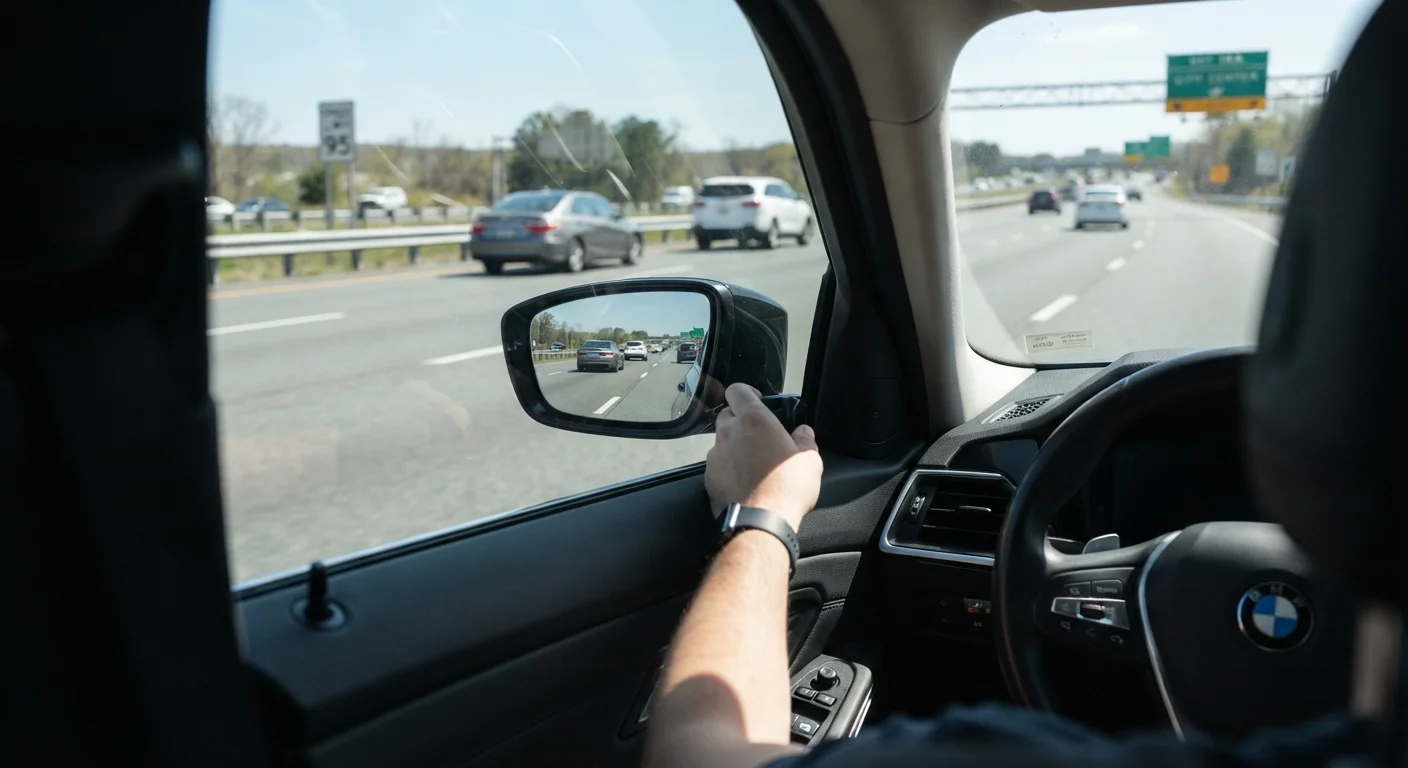
- Driver's side: Lean your head until it nearly touches the driver's window glass. From that position, adjust the mirror until you can just barely see the rear corner of your car. When you sit upright again, the car's body will disappear from the mirror entirely - that's correct.
- Passenger's side: Lean your head to roughly the center of the car (near the rearview mirror). Adjust the passenger mirror until the rear corner of your car is just barely visible from that position. Returning to the normal seating position should again move your car out of frame.
Rearview Mirror
The rearview mirror should frame the full rear window with minimal bezel showing. Tilt it so the horizon line in the image falls in the upper half of the mirror - this maximizes what you see of the lanes behind you while reducing glare from headlights at night. For more strategies around low-visibility driving, see our guide to night driving skills.
Adjustment Takes Time to Feel Natural
After reconfiguring your mirrors using the outward technique, your car will largely disappear from your side mirrors - and that will feel wrong for several days. Do not revert to the old position just because it feels more comfortable. The disorientation fades within a week of regular driving, after which the expanded coverage becomes the new normal.
What to Expect After You Adjust
The first few days after reconfiguring your mirrors can feel disorienting. Drivers often report the urge to push the side mirrors back inward because they no longer see their car. Resist that urge - the discomfort is simply unfamiliarity, not a sign that something is wrong.
What you will notice: as a car passes you, it should travel smoothly from your rearview mirror into the edge of your side mirror, and then into your peripheral vision - a continuous handoff with no gap. That continuity is the goal. If a vehicle seems to vanish between mirrors, your side mirrors still need to move slightly outward.
Properly adjusted mirrors don't eliminate the need for head checks before changing lanes. They reduce the blind spot significantly, but a quick glance over your shoulder remains good practice, particularly in heavy traffic or challenging conditions like rain and reduced visibility. Adapting your technique in rain, ice, and fog covers the full picture when conditions make any gap in visibility more consequential.
~840,000
U.S. blind-spot crashes per year
The National Highway Traffic Safety Administration (NHTSA) has estimated that blind-spot-related lane-change crashes number in the hundreds of thousands annually in the United States.
~3°
Outward angle change that eliminates most blind spots
SAE International research on the BGE (Blind-Zone Glare Elimination) mirror technique found that a modest outward rotation of roughly 3 degrees per side is sufficient to close the gap between the rearview and side mirrors for most passenger vehicles.