

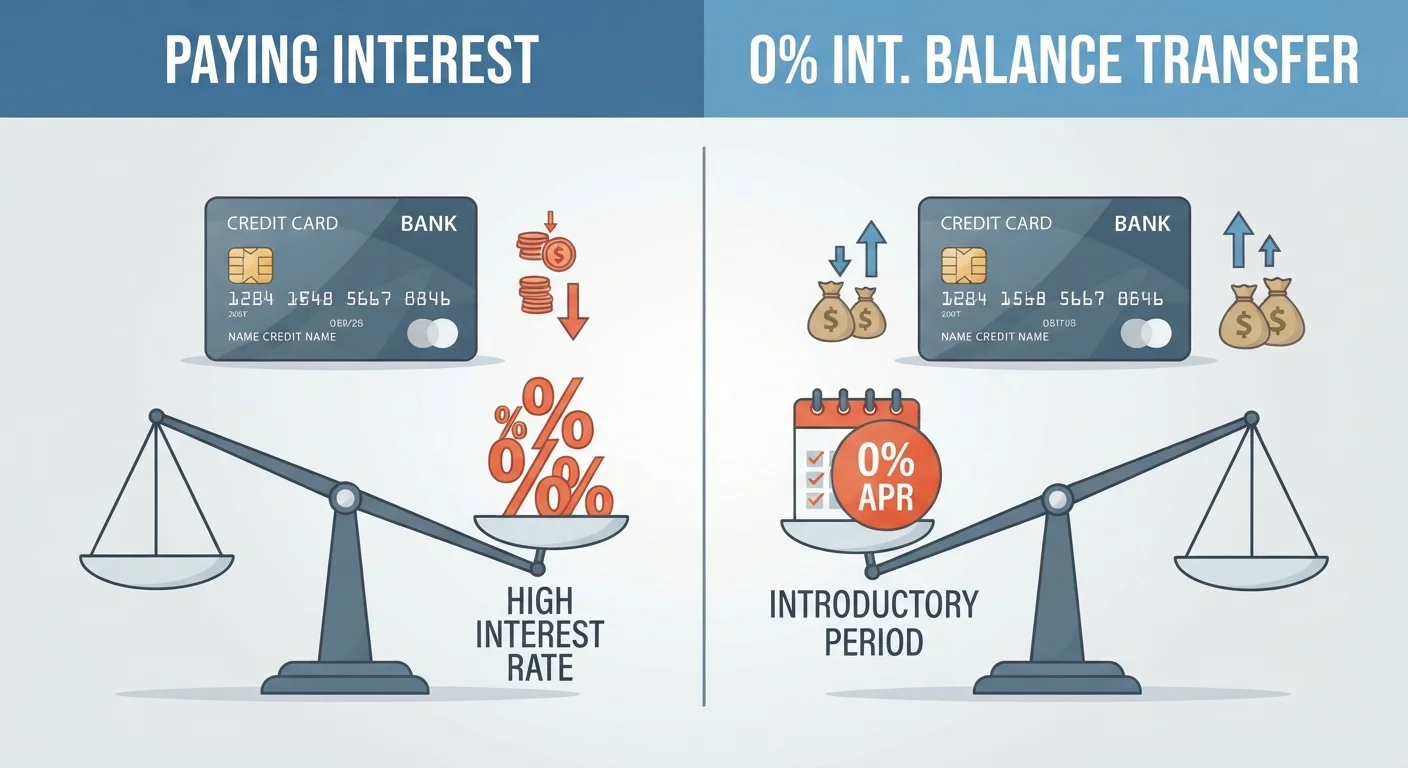
What a Balance Transfer Actually Does
A balance transfer moves outstanding debt from one or more credit cards to a different card - typically one offering a 0% introductory annual percentage rate (APR) for a defined promotional period. That period commonly ranges from 12 to 21 months, depending on the card and your creditworthiness. During that window, no interest accrues on the transferred amount, which means every dollar you pay goes directly toward reducing principal.
The catch: nearly all balance transfers carry an upfront fee, generally 3% to 5% of the amount transferred. On a $5,000 balance, that's $150 to $250 paid immediately. That fee is the baseline cost of the strategy, and it's worth calculating whether the interest savings exceed it before committing. After the promotional period ends, any remaining balance reverts to the card's standard APR, which can be substantial.
Understanding this structure is the starting point. Whether it benefits you depends on what comes next. For a broader look at how debt consolidation options compare, see our article on debt consolidation trade-offs.
Scenarios Where a Balance Transfer Makes Sense
The strategy works best in a specific set of circumstances.
| Factor | Balance Transfer Works Well | Balance Transfer May Not Work | |
|---|---|---|---|
| Credit score | Good to excellent (670+) | Below 670 or thin credit history | |
| Debt type | High-interest credit card balances | Loans, mixed debt, or small balances | |
| Repayment plan | Clear, budgeted monthly payment | No plan or minimum-only payments | |
| Spending behavior | No new purchases planned | Continued charging on old or new card | |
| Income stability | Steady, predictable cash flow | Variable or uncertain income | |
| Fee vs. savings math | Interest saved clearly exceeds transfer fee | Fee offsets most or all potential savings |
You Have a Concrete Repayment Plan
The 0% window only helps if you actually use it to eliminate debt. Divide the transferred balance by the number of promotional months - that's the monthly payment required to clear it entirely before interest resumes. If that figure fits your budget, the transfer is likely sound. If it doesn't, you'll end the period with a remaining balance suddenly accruing standard interest.
Your Credit Score Qualifies You for Competitive Offers
Introductory 0% offers are generally reserved for applicants with good to excellent credit - roughly a FICO score of 670 or higher, though requirements vary by issuer. If your score is lower, you may not qualify, or you may receive a shorter promotional window or a higher standard rate, which changes the calculus considerably.
The Debt Is Purely Credit Card Debt
Balance transfers are most relevant for high-interest revolving credit card balances, not for personal loans, auto debt, or medical bills. Some cards allow transfers from other sources, but the fee structure and terms vary, and the benefit narrows. Credit card interest rates - frequently above 20% APR - create the biggest opportunity for a 0% transfer to generate meaningful savings.
Situations Where a Balance Transfer Can Backfire
Watch for Deferred Interest vs. True 0% APR
Some promotional financing offers - particularly from retail cards - use deferred interest rather than a true 0% APR. With deferred interest, if you carry any remaining balance at the end of the promotional period, interest is retroactively charged on the original amount from day one. This is fundamentally different from a standard 0% offer where interest simply resumes on the remaining balance. Always confirm which structure applies before transferring a balance.
You Don't Change the Spending Behavior That Created the Debt
Transferring a balance to a new card while continuing to charge expenses to the original card - or to the new one - typically worsens the situation. The old card now has available credit, which can feel like breathing room, but using it rebuilds the debt you just moved. The transfer buys time; it doesn't resolve the underlying pattern.
The Fee Erases the Savings
If your balance is relatively small or the remaining standard-rate interest you would have paid is modest, the transfer fee may cost more than you save. Run the arithmetic: calculate total interest under your current card's rate over the payoff period, then subtract the transfer fee from that figure. If the result isn't meaningfully positive, the effort and credit inquiry may not be worth it.
Your Income Is Unstable or the Payment Isn't Realistic
Missing a payment during the promotional period - or failing to meet minimum payment thresholds - can trigger penalty terms with some issuers, potentially voiding the 0% rate entirely. If your cash flow is irregular or the required monthly payment is a stretch, the risk of that outcome is real. It's also worth noting that opening a new card affects your credit profile; our article on why closing old credit cards can backfire explains how related decisions interact with your score.
Making the Decision Clearly
A balance transfer is a financing tool, not a debt solution. The debt doesn't disappear - it moves, and the clock starts immediately. Before initiating one, confirm three things: that the math favors the transfer after fees, that the required monthly payment fits your actual budget, and that you won't add new balances during the promotional period.
If those conditions hold, a transfer can be a rational way to reduce interest drag and accelerate payoff. If they don't, other approaches - such as negotiating directly with your current issuer, working with a nonprofit credit counselor, or exploring structured repayment plans - may serve you better. For additional context on credit decisions, our piece on common credit myths addresses several widely held misconceptions that affect how people evaluate their options.
This article is for general informational and educational purposes only and does not constitute personalized financial or credit advice. Consult a qualified financial professional before making decisions about your specific debt situation.