

What 'Strict Budget Categories' Actually Means
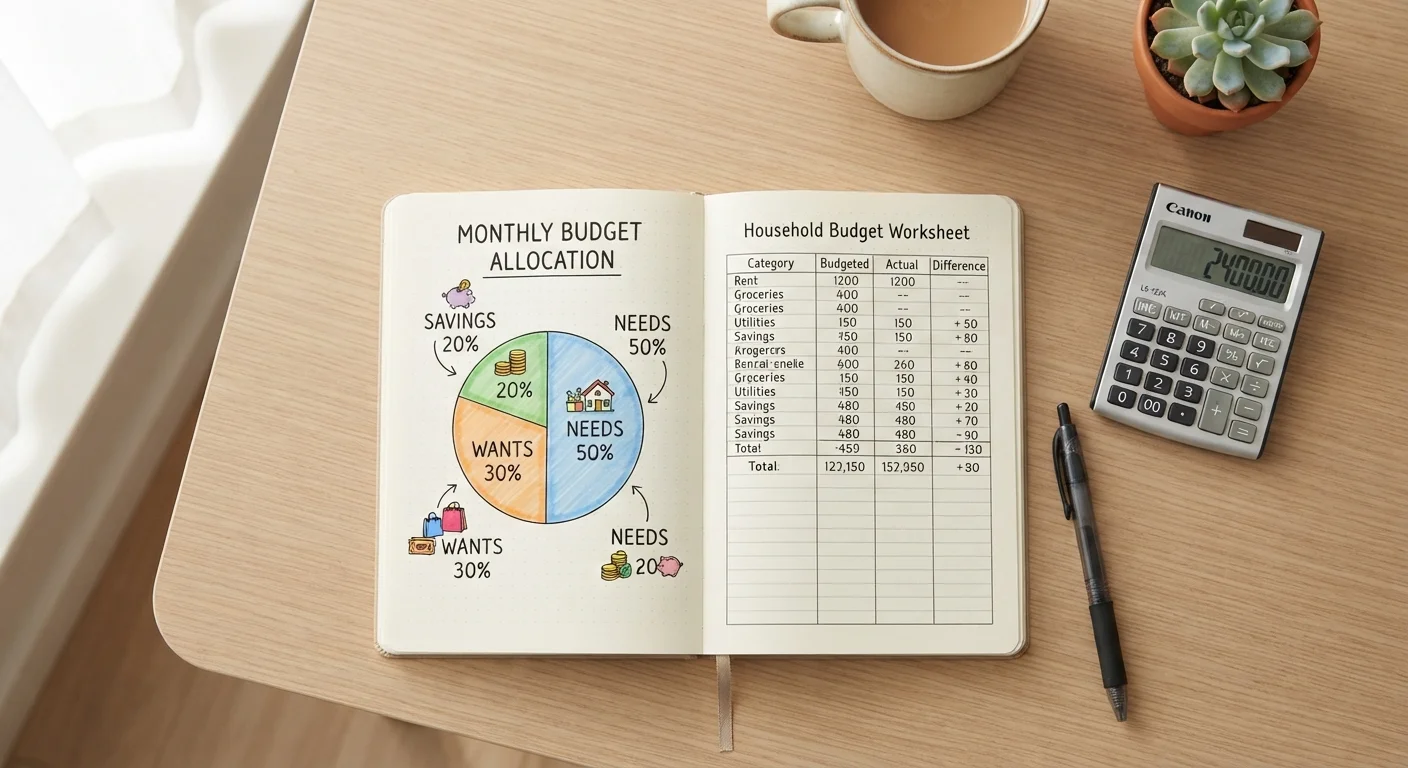
A strict categorical budget assigns a fixed dollar amount - or a hard percentage of income - to each area of spending before the month begins. Groceries get $400. Transportation gets $250. Entertainment gets $75. When a category is exhausted, spending in that area stops until the next cycle.
This approach contrasts with looser systems where a single overall spending limit governs all discretionary purchases together. Methods like the 50/30/20 framework sit somewhere in between - broad buckets rather than granular line items.
Strict systems are the foundation of envelope budgeting and many zero-based budgeting approaches. The discipline they impose is their defining feature - and also their central limitation. For a practical list of typical categories to consider, see our room-by-room look at household spending categories.
The Case For Strict Budget Categories
Structure has real advantages, particularly for adults who want to move from vague financial awareness to deliberate control.
Creates full visibility into spending patterns
Assigning money to named categories forces you to confront exactly where every dollar goes, often revealing spending patterns that went unnoticed under a single account balance view.
Reduces decision fatigue mid-month
When limits are set in advance, individual spending decisions become simpler - the category either has room or it doesn't, removing the need for repeated cost-benefit calculations.
Supports specific savings goals
Allocating a dedicated category to savings - rather than saving whatever's left over - dramatically increases the likelihood that savings actually happen each month.
Easier to identify and fix overspending
When a budget runs short, category-level tracking pinpoints the source immediately, allowing targeted adjustments rather than broad, demoralizing cuts.
Builds financial awareness and habits over time
Consistent tracking teaches you your own spending rhythms, making future budgets more accurate and reducing the need for strict enforcement as habits improve.
~33%
Americans with a formal written budget
Gallup polling has consistently found that only around one-third of U.S. adults maintain a detailed household budget, suggesting most people operate without structured category limits.
Top reason
Why people abandon budgets: too complicated
Consumer finance surveys routinely find that perceived complexity - not lack of motivation - is the most frequently cited reason adults give up on budgeting systems.
Beyond awareness, strict categories force intentional trade-offs. When you've allocated $300 to dining out and it's gone by the 20th, the choice becomes concrete - not abstract. That friction is precisely the point. Research in behavioral economics consistently shows that making costs salient reduces impulsive spending.
Categories also serve as a diagnostic tool. When a budget is under strain, specific line items reveal the problem rather than leaving you guessing why the account balance dipped.
The Case Against Strict Budget Categories
Despite their advantages, rigid systems carry real costs - practical and psychological.
Real life rarely matches category assumptions
Months vary: a medical co-pay, a car repair, or a birthday gift can blow a category instantly. Rigid systems often have no graceful way to absorb irregular but legitimate expenses.
Can create an all-or-nothing mindset
When one category is exceeded, some people treat the entire budget as failed and abandon it. This "what-the-hell effect" - well-documented in self-regulation research - makes strict systems psychologically risky.
High maintenance burden deters long-term use
Tracking and reconciling a dozen or more categories each month requires significant ongoing effort. Complexity is one of the most common reasons people stop budgeting altogether.
Categories may not reflect how you actually spend
Standard budget categories are often based on averaged household data. If your life doesn't match that template, forcing spending into ill-fitting buckets produces friction without useful insight.
Can mask unhelpful spending in compliant categories
Staying within every category limit can feel like success even when overall financial priorities - like emergency savings or debt repayment - remain unaddressed.
Perhaps the most important downside is what researchers sometimes call "budgeting fatigue": the mental overhead of tracking, adjusting, and policing many categories simultaneously. This is a leading reason people abandon budgets entirely. A system that's theoretically sound but practically unsustainable produces worse outcomes than a simpler approach you'll actually maintain.
There's also the risk of misallocated rigidity - spending enormous effort controlling small categories while ignoring larger, less visible leaks. Tracking every $4 coffee while a $200 subscription sits unexamined is a common trap.
If you're concerned a strict system might collapse under pressure, building in flexibility from the start can help the plan survive real-world disruptions.
Finding the Right Level of Structure for You
The binary of "strict" versus "loose" budgeting is a false choice for most people. A more useful question is: which categories in my life genuinely benefit from hard limits?
The 'Sinking Fund' Strategy Worth Knowing
One practical fix for the irregular-expense problem is a sinking fund: a category that accumulates a small amount each month to cover predictable-but-infrequent costs like car maintenance, holiday gifts, or annual subscriptions. This preserves the structure of strict categories while building a cushion for real-life variability. It works within both envelope-style and app-based systems.
A practical middle path is to apply strict limits only to your highest-risk categories - the areas where you historically overspend - while grouping lower-stakes discretionary spending into a single flexible pool. This reduces tracking friction while preserving discipline where it counts most.
If you're unsure whether a category-based or limit-based approach suits your habits, comparing envelope budgeting to digital spending caps can clarify which mechanics fit how you actually behave. You might also want to revisit common budgeting myths that may be shaping your assumptions before you commit to any system.
This article is for general informational and educational purposes only. It does not constitute personalized financial or investment advice. For guidance specific to your financial situation, consider consulting a qualified financial professional.