
The Four Main Insulation Types at a Glance
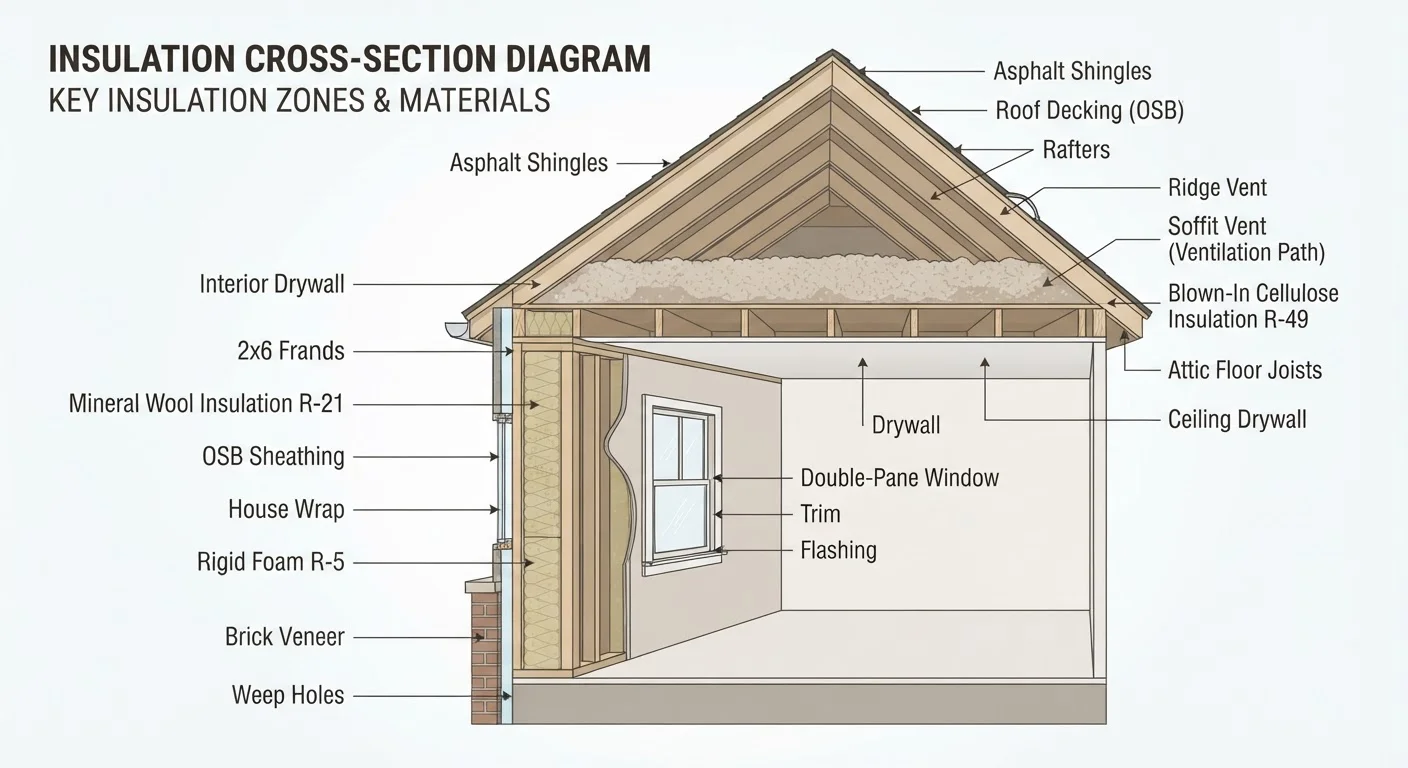
Insulation is not one-size-fits-all. Each type has a distinct physical form, a characteristic R-value range (its resistance to heat flow per inch), and a set of locations where it performs best. Choosing the wrong type for a given space won't just underperform - it can lead to moisture problems or installation gaps that defeat the purpose entirely.
The four types most commonly used in U.S. residential construction are batt insulation, blown-in (loose-fill) insulation, rigid foam board, and spray foam. Each is covered in detail below.
Batt Insulation: Walls, Floors, and Standard Framing
Batt insulation - available in fiberglass or mineral wool - comes in pre-cut blankets sized to fit standard 16-inch or 24-inch on-center stud and joist spacing. It is the most widely recognized insulation form and is well suited to:
- Exterior walls during new construction or a gut renovation
- Floor cavities above unheated crawl spaces
- Basement rim joists (the framing at the top of foundation walls)
R-value per inch typically ranges from about R-3.1 to R-4.3, depending on the material and density. Mineral wool batts are inherently fire-resistant and perform better when slightly damp compared to fiberglass, making them a practical choice in areas prone to minor moisture exposure.
Installation note: Batts must completely fill their cavity without compression or gaps. Compressed insulation loses R-value; voids allow air convection that dramatically reduces effective performance. Faced batts (those with a paper or foil vapor retarder) should always be installed with the facing toward the warm-in-winter side of the assembly.
Blown-In Insulation: Attics and Irregular Spaces
Blown-in, or loose-fill, insulation is installed using a machine that blows fiberglass or cellulose material through a hose. Its free-flowing nature lets it fill around obstructions - pipes, wiring, joists - without the air gaps that batts can leave behind.
Ideal locations include:
- Open attic floors, where it can be blown to any depth to hit the target R-value
- Finished attic knee walls using netting to hold the material in vertical cavities
- Existing wall cavities in retrofit situations via small holes drilled and later patched
Cellulose (made from recycled paper treated with borate fire retardants) achieves roughly R-3.2 to R-3.8 per inch. Fiberglass loose-fill runs slightly lower at about R-2.2 to R-2.7 per inch but does not settle as much over time. For a well-insulated attic, the U.S. Department of Energy generally recommends R-38 to R-60 in most climate zones - which translates to a substantial depth of blown-in material.
Settling Allowance for Blown-In Insulation
Cellulose insulation is known to settle over time, typically by 15-20% of its installed depth. Installers routinely compensate by blowing material slightly deeper than the final target depth. When reviewing installation specifications, confirm the contractor's installed depth accounts for settling so the long-term R-value meets your target.
Rigid Foam Board: Exterior Sheathing, Basements, and Under-Slab
Rigid foam panels are manufactured from expanded polystyrene (EPS), extruded polystyrene (XPS), or polyisocyanurate (polyiso). They deliver a high R-value in a thin profile and are the go-to choice when space is limited or when continuous insulation is needed to reduce thermal bridging through framing.
Common applications:
- Exterior wall sheathing under cladding to interrupt thermal bridges
- Basement walls, attached to the interior face of foundation walls
- Under concrete slabs before a pour
- Garage doors and attic hatches as an added layer
R-values vary significantly: EPS runs around R-3.6-4 per inch; XPS around R-5; polyiso around R-5.6-6.5 (though polyiso performance drops in very cold temperatures). Rigid foam requires a thermal barrier - typically ½-inch drywall - when installed on interior surfaces, per most building codes. Verify local requirements with your building department before proceeding.
Spray Foam: Air Sealing and Problem Geometries
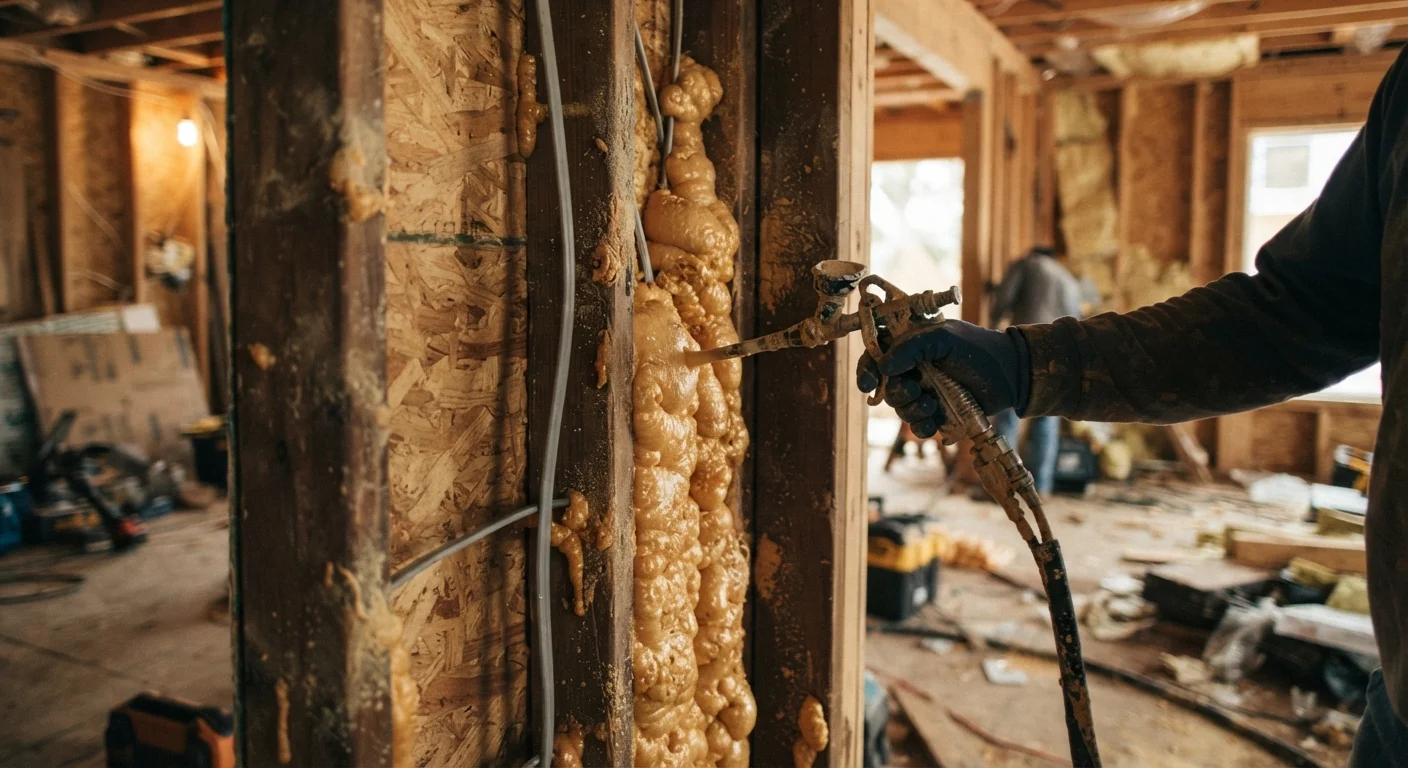
Spray polyurethane foam (SPF) is applied as a liquid that expands and hardens on contact. It comes in two forms: open-cell (lower density, around R-3.5 per inch, vapor-permeable) and closed-cell (higher density, around R-6-7 per inch, vapor retarder). Spray foam's primary strength is that it simultaneously insulates and air-seals - a significant advantage since air leakage is responsible for a large portion of home heat loss.
It excels in:
- Crawl space walls and rim joists
- Irregular rooflines and cathedral ceilings
- Around window and door rough openings (low-expansion canned foam)
- Unvented attic assemblies (closed-cell applied to the underside of roof decking)
Professional installation is strongly recommended for full-coverage applications. Improperly mixed or applied spray foam can off-gas chemicals during and after curing. Installers should follow manufacturer cure times before occupancy. For a deeper look at common misunderstandings, see our guide to spray foam myths.
R-Value
A measure of thermal resistance - how effectively a material slows heat flow. Higher R-values indicate better insulating performance. Codes specify minimum R-values by location and climate zone.
Thermal Bridging
Heat transfer that bypasses insulation by moving through more conductive materials like wood studs or metal framing. Continuous insulation layers (such as rigid foam sheathing) are used to interrupt these bridges.
Vapor Retarder
A material that slows the movement of water vapor through a building assembly. It helps prevent moisture from condensing inside walls or ceilings, reducing the risk of mold and structural damage.
Air Sealing
The process of closing gaps, cracks, and penetrations in the building envelope to stop uncontrolled air movement. Effective air sealing works together with insulation to reduce energy loss.
Open-Cell Spray Foam
A lower-density form of spray polyurethane foam with a softer, spongy texture. It is vapor-permeable and provides sound attenuation, but has a lower R-value per inch than closed-cell foam.
Closed-Cell Spray Foam
A high-density spray foam with a rigid structure that acts as both an insulator and a vapor retarder. It has a higher R-value per inch than open-cell foam and adds structural rigidity to assemblies.