
What a Posted Speed Limit Actually Means
A speed limit sign tells you the maximum legal speed for that stretch of road under normal, dry conditions with good visibility. It is not a suggested cruising speed, nor is it a floor below which you must never drive. Speed limits in the U.S. are established by individual states and municipalities, meaning the same type of road can carry different limits depending on where you are.
Most U.S. states follow one of two statutory frameworks. Under a prima facie system, the posted number creates a rebuttable presumption - you can theoretically argue in court that your speed was safe, even if over the limit. Under an absolute limit system, exceeding the posted number is a violation regardless of conditions. California and Texas use prima facie frameworks for most roads; many other states apply absolute limits. Knowing which system applies in your state matters when contesting a ticket.
Special posted limits - school zones, work zones, and hospital districts - carry their own rules. School zone limits typically apply during posted hours on school days only. Work zone limits generally apply when workers are present, and fines in these areas are commonly doubled under state law.
29%
Of U.S. traffic fatalities involving speeding
According to the National Highway Traffic Safety Administration (NHTSA), speeding was a contributing factor in approximately 29% of all traffic fatalities in a recent reporting year.
12,330+
Speeding-related traffic deaths per year
NHTSA data consistently shows more than 12,000 annual U.S. traffic deaths in which speeding is identified as a factor, underscoring enforcement as a road-safety priority.
20+ mph
Over limit that triggers elevated penalties
In many U.S. states, driving 20 mph or more above the posted limit crosses a statutory threshold that can result in reckless driving charges rather than a standard speeding infraction.
Variable Speed Limits: When the Number on the Sign Can Change
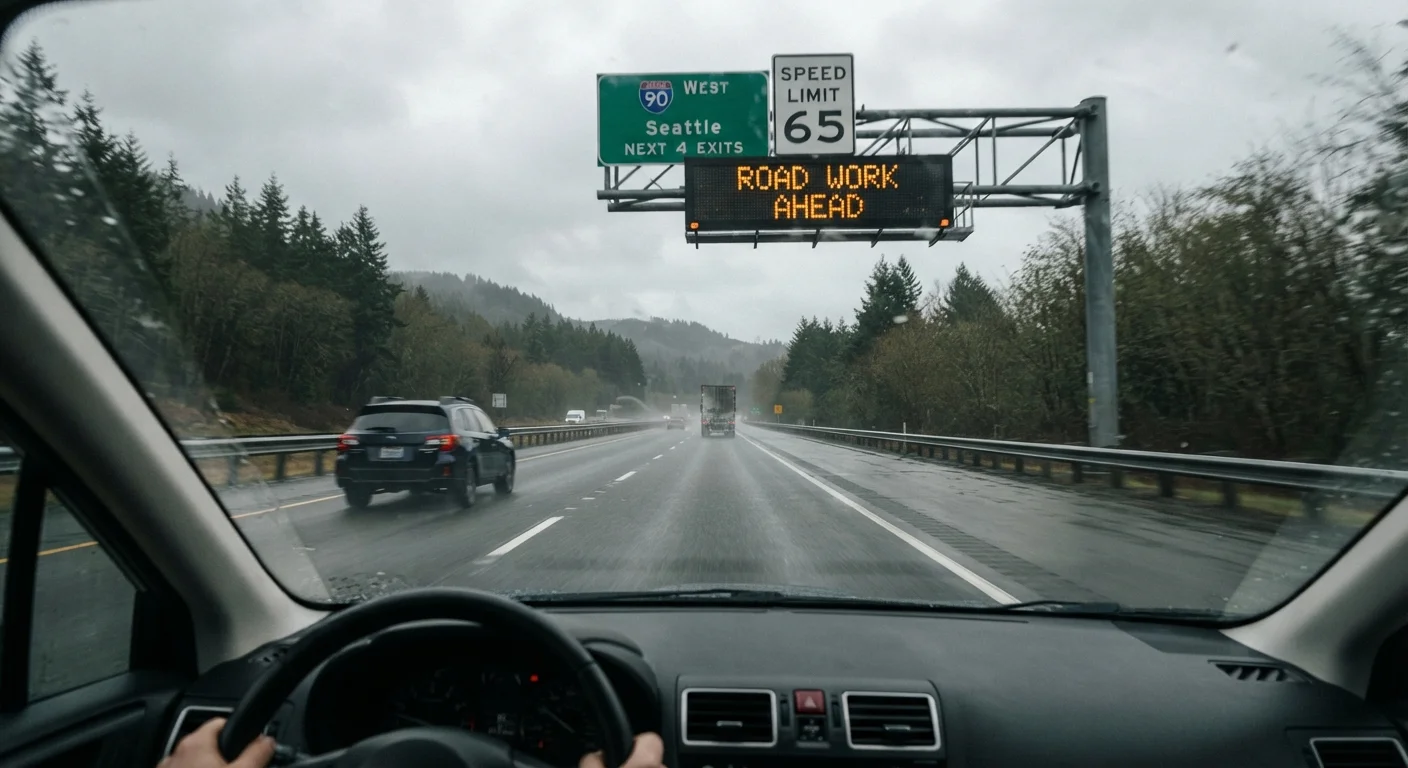
Variable speed limits (VSLs) are electronically displayed limits that adjust in real time based on traffic density, weather, visibility, or incidents ahead. Increasingly common on congested urban freeways and tunnels in states like Washington, Virginia, and Utah, VSLs are designed to smooth traffic flow and reduce crash risk.
A critical point for drivers: a legally displayed variable limit carries the same enforcement weight as a fixed sign. If a gantry over the highway shows 45 mph while a roadside sign still reads 65 mph, 45 mph is the enforceable limit at that moment. Authorities typically require variable limit signs to meet specific visibility and display standards before they can be enforced, but once those standards are met, driving above them is a violation.
Watch Gantry Signs, Not Just Roadside Posts
When driving in unfamiliar city corridors or interstate zones, make a habit of scanning overhead gantry signs in addition to roadside posts. Variable limits displayed on overhead signs take precedence over fixed roadside numbers when both are visible. If you see a lower number overhead, treat it as the current legal limit immediately.
Variable limits can also be set lower than the statutory minimum in some states during adverse conditions, or raised above the fixed daytime limit during low-traffic nighttime hours on some stretches. Always look for overhead gantry signs and dynamic message boards when driving in unfamiliar urban corridors.
How Average Speed Cameras Work - and Why Slowing Down at Camera Points Doesn't Help
Point-to-point speed enforcement, commonly called average speed cameras or SPECS systems, measures your pace between two or more camera stations spaced some distance apart. Here's the mechanism: your license plate is photographed at the entry camera and again at the exit camera. The system divides the distance by the time elapsed to calculate your average speed. If that average exceeds the posted limit, a violation notice is generated.
This approach closes the loophole that traditional single-point speed cameras created - where drivers would brake hard near a camera and accelerate immediately after. With average enforcement, your speed throughout the entire zone determines your compliance. Briefly dropping to the limit at camera locations while speeding in between will still result in a calculated average above the threshold.
In the U.S., average speed enforcement is less widespread than in the UK, but it is deployed in certain highway work zones and tunnel approaches. States including Maryland, Oregon, and New York have used or piloted work-zone average speed camera programs. If you see paired camera installations above the road with distance markers, treat the entire stretch as enforced.
Enforcement Tolerances and the 'Basic Speed Law'
Many drivers believe there is a guaranteed buffer above the posted limit - typically cited as 5 or 10 mph - before enforcement occurs. No such legal buffer exists. What does exist is discretionary tolerance applied informally by officers or camera operators, which can vary by jurisdiction, time of day, staffing levels, and enforcement priorities. Relying on an assumed tolerance as a strategy is not advisable, as it can disappear without notice.
Equally important is understanding the basic speed law, sometimes called the reasonable and prudent standard. Most U.S. states have a version of this doctrine: a driver can be cited for operating at a speed that is unsafe for prevailing conditions, even if that speed is at or below the posted limit. Heavy rain, ice, dense fog, or a roadway accident ahead can make 55 mph in a 65 mph zone an unsafe and potentially citable speed. This is why "driving for conditions" is both a legal obligation and a safety imperative - not just advisory language.
Penalties for speeding scale with how far over the limit you traveled. Most states tier fines and license-point assessments. Conviction for excessive speeding - often defined as 20 mph or more over the limit - can trigger license suspension, mandatory court appearances, and substantial insurance premium increases at renewal.