

Why Some Skills Travel Farther Than Others
Not all skills age at the same rate. A niche software tool can become obsolete within a few years, but the ability to analyze information clearly or communicate under pressure tends to compound in value over time. These are what career researchers and workforce analysts broadly call transferable skills - capabilities that hold genuine utility across sectors, job titles, and organizational types.
For adults weighing where to invest their learning energy, transferable skills offer a meaningful return on time. They reduce career risk, because a skill that works in healthcare also works in logistics or finance. They also reduce retraining costs when industries shift - which, over a 30- to 40-year career, they inevitably will.
Before diving into the list, it's worth clarifying what we mean by "high-value." Here, the term reflects two things: consistent employer demand across multiple sectors, and the skill's role as a multiplier - something that makes other work better. If you want a structured way to evaluate where you currently stand against these skills, the skill gap mapping process is a useful place to start before committing to any course or program.
Data Literacy
Data literacy - the ability to read, interpret, and draw sound conclusions from data - has become a baseline expectation in roles far beyond traditional analytics. Healthcare administrators use it to track patient outcomes. Retail managers use it to manage inventory. Marketing coordinators use it to assess campaign performance.
You don't need to be a statistician. At a functional level, data literacy means understanding how to work with spreadsheets, interpret charts without being misled by them, and ask the right questions of a dataset. This skill pairs naturally with whatever domain expertise you already have, making it a high-leverage addition for most professionals.
Data literacy amplifies every other skill - it lets you make decisions on evidence, not instinct alone.
Clear Written Communication
Writing well is one of the most consistently underrated professional skills. In an era of distributed teams and asynchronous work, the ability to communicate clearly in writing - emails, reports, documentation, proposals - determines whether ideas actually land or get lost in ambiguity.
Strong written communication is distinct from creative writing. It means structuring information logically, anticipating the reader's questions, and editing ruthlessly for clarity. Industries from law and medicine to engineering and education all flag this as a core competency. It's also a skill that improves measurably with deliberate practice - feedback, revision, and regular writing all accelerate development.
Clear writing is the professional world's most universal currency - it works in every industry, at every level.
Project Management
Project management is the discipline of moving work from a starting point to a defined outcome within constraints of time, budget, and scope. While formal methodologies like PMP certification or Agile frameworks exist, the core skill set - defining goals, breaking work into tasks, coordinating stakeholders, managing risk - is universally applicable.
Construction, software, nonprofit programming, event planning, and government contracting all rely on people who can keep complex work organized and on track. Even professionals who don't hold the title of project manager often perform this function as an informal part of their role. Developing a working knowledge of project management principles signals organizational maturity to employers across sectors.
Project management skills signal organizational maturity - employers across every sector value people who keep work on track.
Critical Thinking and Problem Framing
Critical thinking is the ability to evaluate information objectively, identify assumptions, recognize gaps in reasoning, and weigh evidence before drawing conclusions. Problem framing - the related skill of defining a problem accurately before attempting to solve it - is equally important and often overlooked.
Many workplace failures stem not from poor execution, but from solving the wrong problem efficiently. Professionals who can slow down, question the framing of a challenge, and distinguish symptoms from root causes are valuable in virtually any context. This skill is difficult to automate and tends to grow with deliberate exposure to diverse problems and structured reflection.
Solving the wrong problem well is still failure - critical thinking starts with questioning the framing itself.
Adaptability and Learning Agility
Learning agility - the capacity to acquire new skills and knowledge quickly, especially in unfamiliar situations - has emerged as one of the most cited traits in workforce research. It's closely related to adaptability, which refers to adjusting behavior and approach in response to changing conditions.
Both traits are partly dispositional, but both can also be cultivated intentionally. Adults who seek out stretch assignments, actively reflect on what they've learned from setbacks, and build habits of regular learning tend to demonstrate stronger learning agility over time. In industries where tools, regulations, and market conditions shift rapidly, these traits determine who remains relevant.
Learning agility isn't a fixed trait - it grows with deliberate practice, reflection, and a willingness to start uncomfortable.
Interpersonal and Collaborative Skills
The ability to work effectively with other people - across functions, personalities, and sometimes cultures - remains stubbornly hard to replicate through automation. Interpersonal skills encompass active listening, constructive feedback, conflict navigation, and the social awareness to read group dynamics accurately.
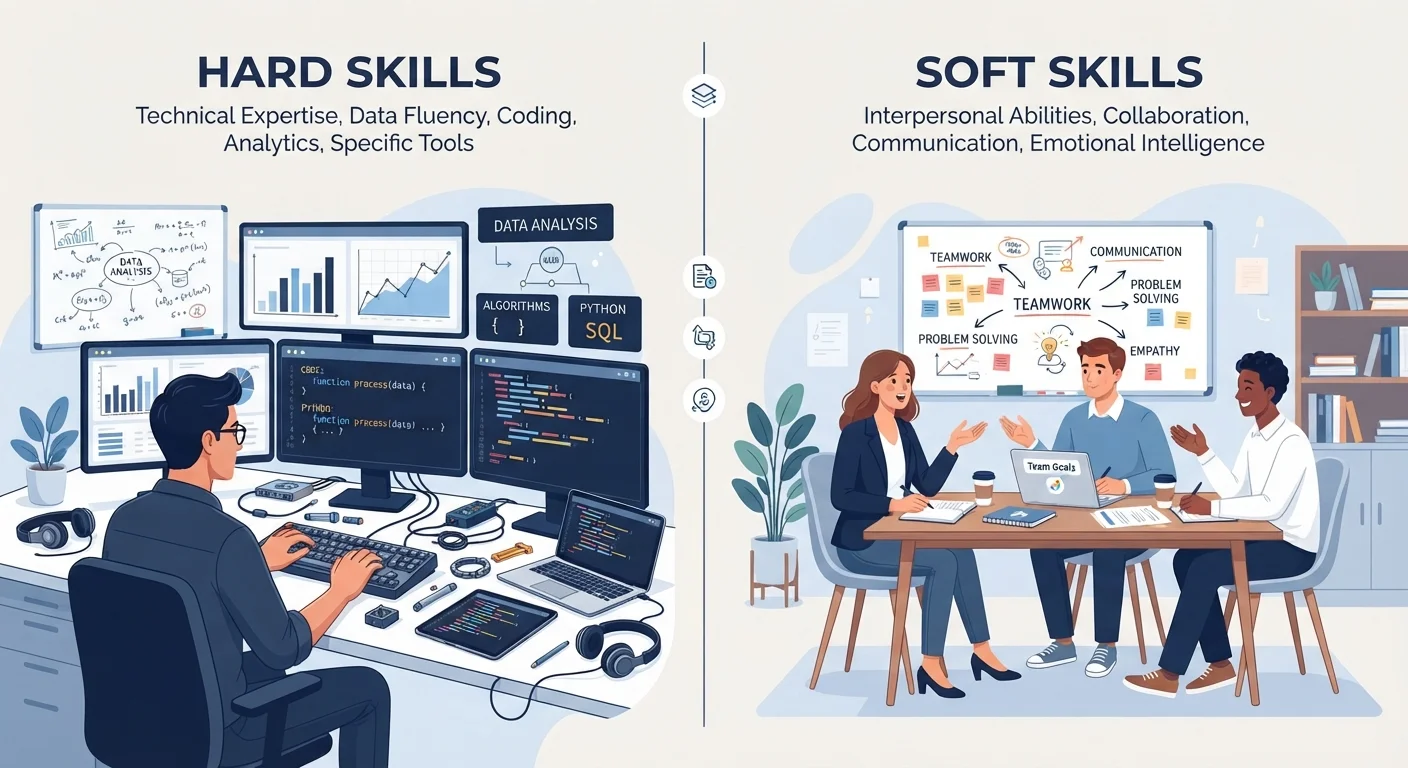
These skills are sometimes labeled "soft," but that framing understates their professional impact. Research consistently shows that team cohesion and communication quality are among the strongest predictors of project success, regardless of industry. For a deeper look at how interpersonal skills relate to technical ones, the hard vs. soft skills distinction is worth understanding in full.
Interpersonal skills are not soft - they are among the most reliable predictors of team and project success.
Building These Skills Strategically
Knowing which skills matter is only part of the equation. The harder question is how to develop them efficiently when you're already working, managing a household, or both. The good news is that most of the skills listed above can be developed through a combination of structured learning and applied practice - you don't need a full degree program for every one of them.
Start With One Skill, Not Six
Trying to develop every skill on this list simultaneously is a reliable path to burnout and shallow progress. Instead, identify the one or two skills most relevant to your current goals or your next career move, and concentrate your energy there. Once those feel practiced and applied, expand from there. The complete skill-building guide for working adults offers a structured approach to prioritizing and sequencing your development.
Online learning platforms have expanded access to structured instruction in areas like data analysis, writing, and project management, often at a fraction of traditional tuition costs. For credentials that carry weight with employers, degrees and certifications worth pursuing vary significantly by field - so it pays to research what hiring managers in your target industry actually recognize.
Whichever path you choose, building skills in isolation rarely produces lasting results. The most durable learning happens when new knowledge is applied quickly in real contexts - at work, in volunteer roles, or in personal projects. For a fuller framework on making skill-building sustainable as an adult, the adult learner's roadmap covers the complete cycle from identifying priorities to maintaining momentum over time.
This article is for general informational and educational purposes only. Career outcomes vary based on individual circumstances, industry conditions, and many other factors. Readers should conduct their own research and consult relevant professionals before making career or education decisions.