

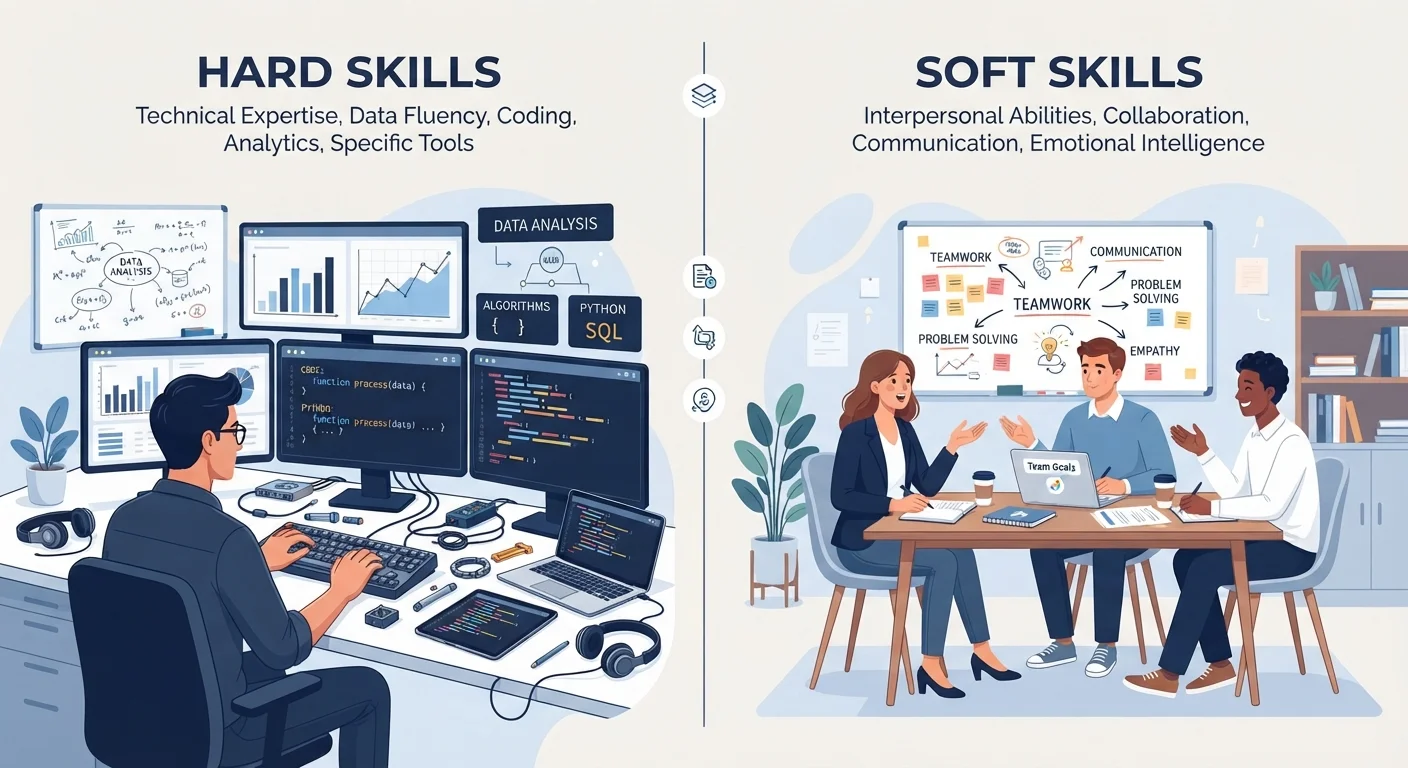
Defining the Terms: What Each Category Actually Means
Hard skills are specific, teachable abilities that can be defined, measured, and typically verified - think data analysis, accounting principles, a programming language, or operating specialized equipment. They are usually acquired through formal education, certification programs, or structured on-the-job training, and they tend to be tied to a particular role or industry.
Soft skills, by contrast, describe how you interact with others and manage yourself - communication, adaptability, problem-solving, teamwork, and time management. These are sometimes called people skills or interpersonal skills, though that framing undersells them. Soft skills also include internal competencies like self-awareness and emotional regulation, which significantly affect how effectively you perform in any environment.
One important correction worth making upfront: the word "soft" does not mean easy to develop or less important. Research from organizations including the World Economic Forum consistently places soft skills - particularly critical thinking and communication - among the most in-demand workplace competencies. See our guide to high-value cross-industry skills for context on how both categories hold up across sectors.
| Criterion | Hard Skills | Soft Skills |
|---|---|---|
| Definition | Specific, task-based technical abilities | Interpersonal and self-management capabilities |
| Measurability | Easily tested, certified, or benchmarked | Assessed through behavior, feedback, observation |
| How acquired | Courses, certifications, structured training | Practice, feedback, reflection, coaching |
| Industry specificity | Often tied to a role or sector | Highly transferable across industries |
| Automation risk | Moderate to high for routine tasks | Low - collaboration and judgment are hard to automate |
| Examples | SQL, accounting, medical coding, welding | Communication, empathy, adaptability, leadership |
| Typical hiring signal | Listed as required qualifications in job posts | Evaluated in interviews, references, and probation |
How Each Type of Skill Is Developed
Hard skills typically follow a structured learning path. You take a course, complete a training program, earn a certification, or accumulate supervised practice hours. Progress is generally measurable: you pass an exam, reach a performance benchmark, or demonstrate proficiency on a defined task. This makes hard skills relatively straightforward to plan for - you can identify the gap, find the curriculum, and track your advancement.
Soft skills are developed less linearly, but they are no less learnable. Improving your ability to communicate clearly, manage conflict, or stay composed under pressure requires deliberate effort - often through reflection, feedback, and repeated real-world practice rather than coursework alone. Research on emotional regulation, for instance, shows it is a trainable capacity, not a fixed personality trait. Our article on emotional regulation as a learnable skill explores this distinction in depth.
Both categories benefit from intentional, structured practice. If you are deciding how to allocate your learning time, our comparison of deliberate practice versus passive learning can help you choose an approach that actually builds capability rather than just familiarity.
92%
Executives citing soft skills as equally or more important than hard skills
According to a survey by LinkedIn, the vast majority of talent professionals say soft skills matter as much or more than technical skills when evaluating candidates.
Top 5
In-demand skills cited by World Economic Forum Future of Jobs reports
Critical thinking, creativity, and collaboration consistently appear among the most sought-after workforce competencies in WEF Future of Jobs research.
~65%
Of jobs requiring medium-to-high social interaction skills
Research from the Brookings Institution suggests that roles emphasizing social and interpersonal skills have grown steadily as a share of employment over recent decades.
Why Employers Want Both - and What the Gap Looks Like in Practice
Most job postings are written around hard skills: specific software, required credentials, years of experience in a defined area. But hiring managers consistently report that candidates who struggle tend to do so because of soft skill deficits - poor communication, difficulty adapting, trouble collaborating under pressure.
This gap between what job ads measure and what employers actually need creates a practical challenge. A candidate who is technically proficient but unable to communicate findings clearly, manage conflict on a team, or adapt when priorities shift will face a ceiling in most organizations. Conversely, someone with strong interpersonal and self-management skills but limited technical foundation may struggle to earn initial credibility in specialized fields.
The most career-resilient professionals treat both skill categories as ongoing development priorities rather than fixed assets. Hard skills require maintenance - tools change, standards evolve, and yesterday's technical knowledge can become obsolete. Soft skills require sustained attention too; they tend to atrophy in environments that don't actively challenge them.
For a practical framework on building both, see our Adult Learner's Roadmap to Building New Career Skills, which walks through how to identify gaps and structure a realistic development plan.