
What Sets These Two Products Apart
Both engineered and solid hardwood feature a genuine wood surface, which is why they're often confused in showrooms. The real difference lies in what's underneath that surface.
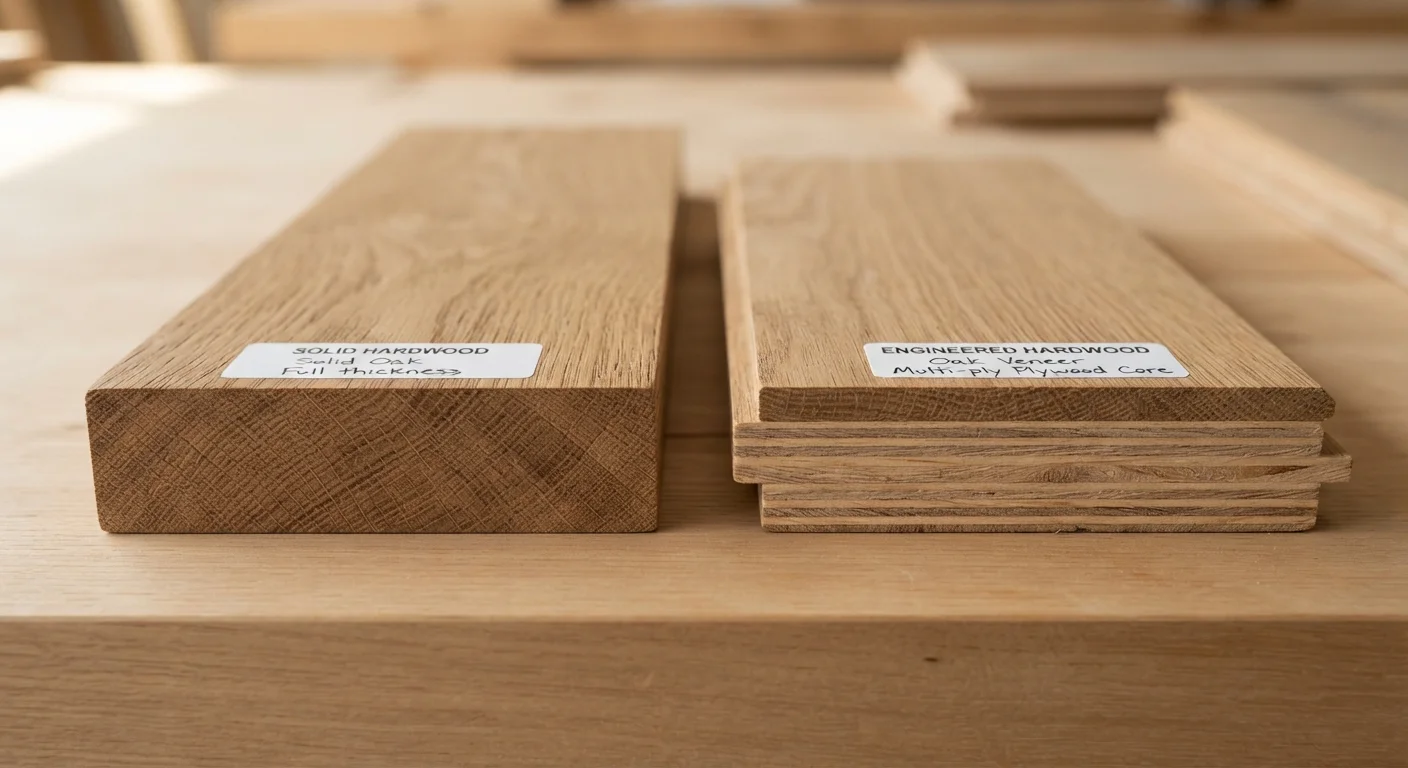
Solid hardwood is milled from a single piece of timber - typically ¾ inch thick - with no layering. That uniform construction is what allows it to be sanded multiple times over decades. However, solid wood is reactive: it expands and contracts with changes in temperature and humidity, which limits where it can be installed.
Engineered hardwood consists of a real hardwood veneer bonded over multiple layers of cross-directional plywood or high-density fiberboard. This construction counteracts wood's natural tendency to move with moisture. The result is a product that looks identical to solid hardwood on the surface but behaves very differently underneath.
| Criterion | Engineered Hardwood | Solid Hardwood |
|---|---|---|
| Construction | Wood veneer over plywood core | Single solid wood plank |
| Moisture resistance | Higher - stable in humid conditions | Lower - sensitive to humidity swings |
| Installation locations | Above, on, or below grade | Above grade only |
| Subfloor compatibility | Wood or concrete | Wood subfloor required |
| Installation methods | Nail, glue, or floating click-lock | Nail or staple only |
| Refinishing potential | 1-4 times (veneer dependent) | 5-8+ times over decades |
| Radiant heat compatible | Generally yes | Limited - manufacturer specific |
| Typical lifespan | 25-30+ years | 50-100+ years with refinishing |
Moisture Tolerance and Installation Flexibility
Moisture resistance is one of the clearest practical dividing lines between these two flooring types. Solid hardwood should only be installed above grade - on upper floors or main levels with a wood subfloor - in rooms with controlled indoor humidity, typically maintained between 35% and 55% relative humidity. It is not suitable for basements or rooms with concrete subfloors due to the moisture vapor that concrete naturally emits.
Engineered hardwood, by contrast, can be installed above, on, or below grade. It is compatible with radiant heat systems and concrete subfloors, making it appropriate for kitchens, finished basements, and open-plan spaces where solid wood would be at risk.
Installation method also varies. Solid hardwood is almost always nailed or stapled to a wood subfloor. Engineered hardwood supports nail-down, glue-down, and floating (click-lock) methods - a meaningful advantage for DIYers and for installations over existing hard surfaces.
¾ inch
Standard solid hardwood plank thickness
This uniform thickness is what allows solid hardwood to be sanded and refinished repeatedly throughout its lifespan.
35-55%
Recommended indoor relative humidity for hardwood floors
The National Wood Flooring Association advises maintaining this humidity range year-round to minimize expansion and contraction in wood flooring.
1⁄16"-⅛"
Typical engineered hardwood veneer thickness range
Thicker veneers allow more refinishing cycles; always verify this specification when comparing engineered hardwood products.
Refinishing Life and Long-Term Value
This is where solid hardwood holds a decisive edge. Because solid planks are a uniform ¾ inch of wood, they can typically be sanded and refinished five to eight times or more over their lifetime - potentially lasting 80 to 100 years with proper care. That multi-generational durability makes solid hardwood a strong candidate for primary living areas where longevity justifies the investment.
Engineered hardwood's refinishing potential depends on the thickness of its top veneer layer, which generally ranges from 1⁄16 inch to ⅛ inch. Products with a thicker veneer (around 4-6mm) can be sanded and refinished two to four times; thinner veneers may only tolerate one light sanding. If you're evaluating engineered products, checking the veneer thickness is an important step before purchasing.
It's worth noting that both flooring types require the same surface maintenance: regular sweeping, prompt spill cleanup, and protection from heavy furniture. Neither type is scratch-proof, and area rugs in high-traffic zones extend the finish life of both.
Cost, Aesthetics, and Making Your Decision
Material costs for engineered and solid hardwood overlap considerably, depending on wood species, plank width, and veneer quality. Installation costs can differ: floating engineered floors may cost less to install because the method is faster and requires fewer specialized tools. Glue-down or nail-down engineered installation typically falls in a similar range to solid hardwood installation.
Aesthetically, both options are available in a wide range of species, stains, and finishes. Because the top layer of engineered hardwood is genuine wood, it is visually indistinguishable from solid hardwood once installed. Wide-plank formats - increasingly popular in open-plan interiors - are often more dimensionally stable in engineered form, since wider solid planks are more prone to movement.
The clearest decision framework: choose solid hardwood if you're installing above grade in a climate-controlled room and want maximum refinishing life. Choose engineered hardwood if moisture, subfloor type, radiant heat, or a floating installation method are factors in your project.
Cost and installation figures vary by region, contractor, and product. Always obtain multiple quotes and verify local building requirements before beginning any flooring project.