

Why Sugar Wears So Many Disguises
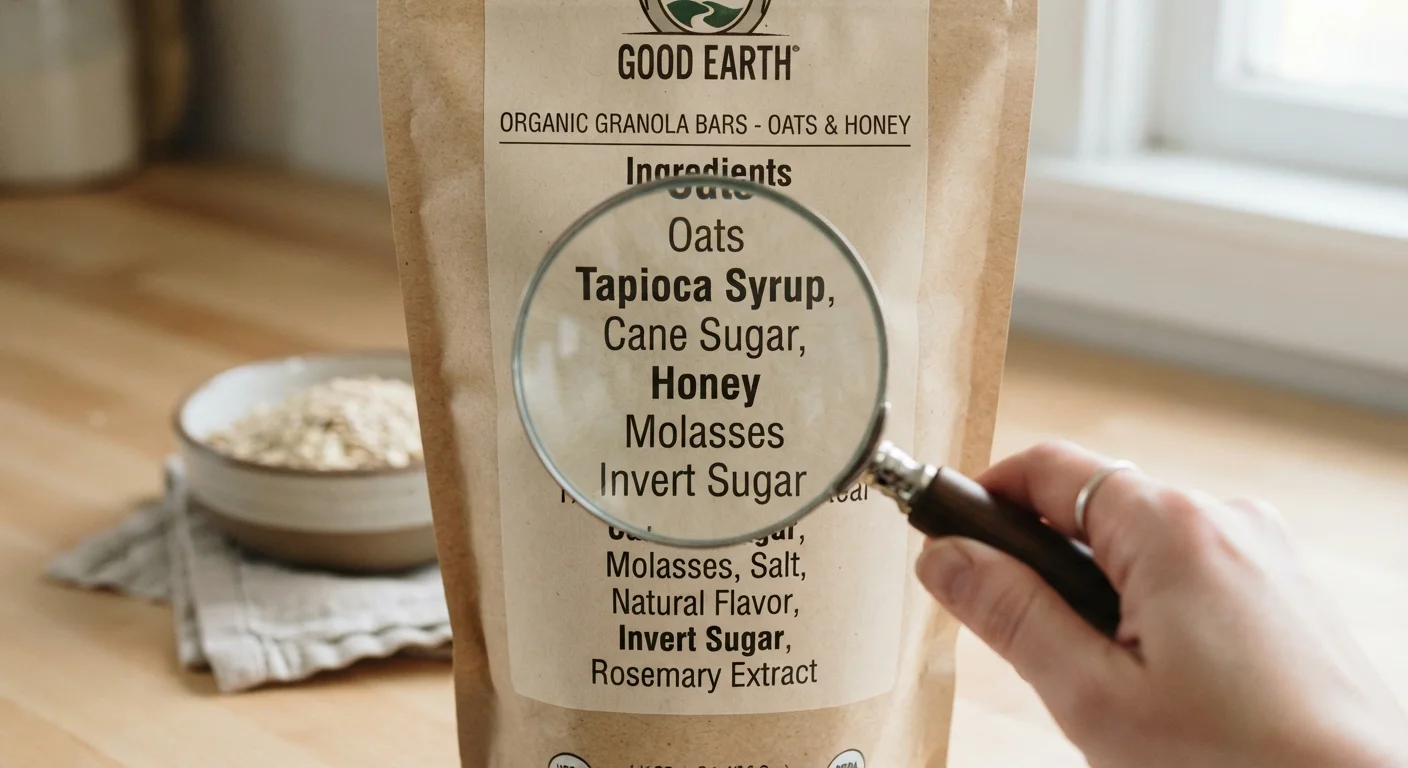
Food manufacturers use dozens of legally distinct names for added sugars. Some reflect the sugar's source (cane, beet, coconut palm), some describe its chemical structure (fructose, maltose, dextrose), and others refer to the processing method used to produce it (evaporated cane juice, hydrolysed starch). The result: a single product can contain four or five different sugar-derived ingredients, each appearing separately on the label - which can push each one further down the ingredient list than a single entry would warrant.
Understanding these aliases is not about eliminating sugar from your diet. It is about seeing clearly what you are consuming so you can make realistic, informed choices. For a broader walkthrough of how to interpret the numbers on a nutrition panel, see our guide to reading a nutrition label.
| Added Sugars line required since | 2020 (large manufacturers); 2021 (smaller manufacturers) (U.S. Food and Drug Administration nutrition label update) |
| Reference daily intake for added sugars | 50 grams (based on 2,000-calorie diet) (FDA Nutrition Facts label %DV reference) |
| Approximate number of sugar aliases | 60+ names commonly documented (University of California San Francisco SugarScience project estimates) |
| Ingredient list ordering rule | By weight, descending - heaviest ingredient listed first (FDA food labeling regulations (21 CFR 101.4)) |
| Sugar alcohols counted in Added Sugars? | No - listed separately under Total Carbohydrate (FDA Nutrition Facts panel guidelines) |
The Most Common Names for Added Sugar
The list below groups added-sugar aliases by category. It is not exhaustive - food scientists continue to develop new sweetener forms - but it covers the terms most commonly found on US packaged-food labels.
Syrups
- High-fructose corn syrup (HFCS)
- Corn syrup / corn syrup solids
- Brown rice syrup
- Malt syrup
- Maple syrup
- Agave nectar or agave syrup
- Golden syrup
- Sorghum syrup
"-ose" Sugars (monosaccharides and disaccharides)
- Sucrose (table sugar)
- Fructose (fruit sugar in isolated form)
- Glucose
- Dextrose
- Maltose
- Lactose (the milk sugar - naturally occurring in dairy, but added in some processed foods)
- Galactose
Words Ending in "-ol" (sugar alcohols)
Sugar alcohols such as sorbitol, xylitol, maltitol, and erythritol are chemically distinct from sugar and generally contribute fewer calories per gram. They are listed separately on the Nutrition Facts panel under "Total Carbohydrate" and are not counted in the "Added Sugars" line. However, they can affect blood sugar and may cause digestive discomfort in larger amounts. People managing specific health conditions should discuss sugar alcohol intake with a healthcare provider.
"Natural" or Less-Processed Forms
- Evaporated cane juice / cane juice crystals
- Coconut sugar / coconut palm sugar
- Date sugar / date syrup
- Raw sugar / turbinado sugar / demerara sugar
- Molasses / blackstrap molasses
- Honey
Added Sugars
Sugars and syrups added to foods during processing or preparation, as opposed to sugars naturally present in whole fruits, vegetables, or dairy. The FDA requires this figure to appear as its own line on the Nutrition Facts panel.
High-Fructose Corn Syrup (HFCS)
A liquid sweetener derived from corn starch in which some glucose has been converted to fructose. It is widely used in processed foods and beverages and is counted as an added sugar.
Dextrose
Another name for glucose derived from corn or wheat starch. It is chemically identical to blood glucose and is classified as an added sugar on food labels.
Sugar Alcohols
A class of carbohydrates (e.g., xylitol, erythritol, sorbitol) that provide sweetness with fewer calories than sugar. They are not counted in the Added Sugars figure but are included under Total Carbohydrate on the Nutrition Facts panel.
Evaporated Cane Juice
A minimally processed sweetener made by dehydrating sugar cane juice. Despite its natural-sounding name, it is considered an added sugar and metabolized similarly to refined sucrose.
Percent Daily Value (%DV)
A reference figure on the Nutrition Facts panel showing how much a nutrient in a serving contributes to a general 2,000-calorie daily diet. It is a benchmark, not a personal recommendation.
Regardless of source or processing level, these ingredients contribute to the "Added Sugars" total on the Nutrition Facts panel once they are added during manufacturing. From a metabolic standpoint, the body processes them similarly to refined white sugar, though the amounts per serving and accompanying nutrients (fiber, minerals) can vary.
How to Use This Knowledge at the Store
The FDA-mandated Nutrition Facts panel is your most reliable reference. The "Added Sugars" line, introduced in updated labeling rules, tells you the grams of sugar added during production - distinct from sugars naturally present in fruit, dairy, or vegetables. The accompanying percent Daily Value (%DV) is based on a reference intake of 50 grams of added sugar per day for a 2,000-calorie diet. This is a general reference figure, not a personal prescription; your own appropriate intake depends on factors best discussed with a registered dietitian or healthcare provider.
When scanning ingredient lists, apply this practical approach:
- Count the aliases. If you spot three or four sugar-type ingredients in the first five items, the product is likely high in added sugar even if no single entry appears prominent.
- Check ingredient order. Ingredients are listed by weight, descending. An added sugar appearing in the top three indicates it is one of the product's primary components.
- Cross-check with the panel. The grams of added sugar on the Nutrition Facts panel reflect the combined total of all added-sugar ingredients - a single reliable number to anchor your assessment.
This article is for general informational and educational purposes only and does not constitute medical or dietary advice. Consult a qualified healthcare professional or registered dietitian for guidance specific to your health needs.